



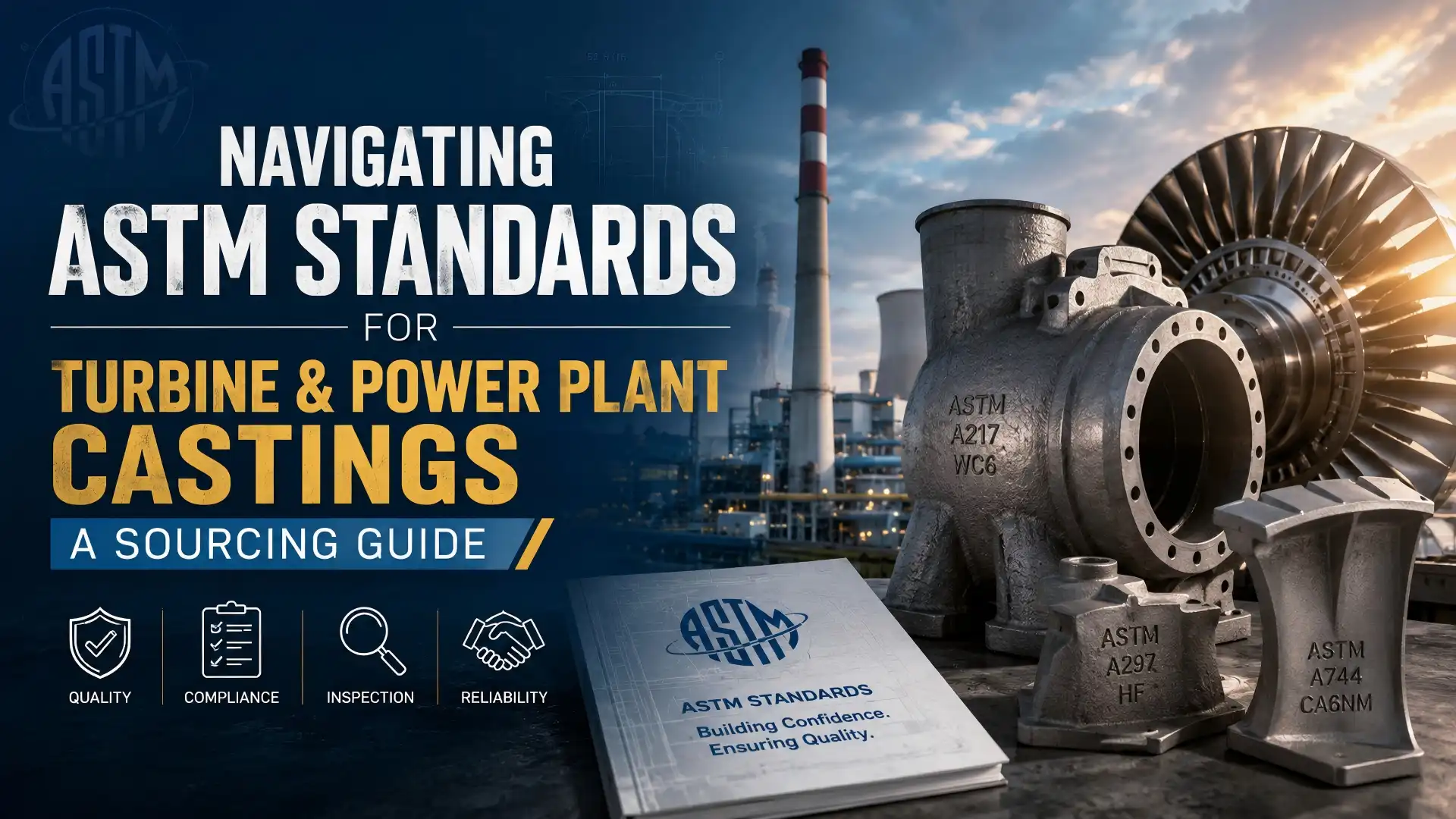
When sourcing critical components for the energy sector, material reliability is simply non-negotiable. For OEM buyers and engineers, understanding the strict ASTM requirements for turbine & power plant castings is the first step to preventing heat fatigue and ensuring long-term operational safety. This comprehensive sourcing guide breaks down the essential material specifications you need to know to secure high-quality, compliant heavy steel parts from your foundry partners.
MATERIAL SCIENCE & ENGINEERING
HOW TO SPECIFY THE RIGHT ALLOYS,
VERIFY FOUNDRY COMPLIANCE,
AND PREVENT COSTLY FAILURES IN HEAVY STEEL COMPONENTS.
Read Article
Hanhai Engineering Team
May 15, 2026 | 6 MIN READ
CONTENTS
1. The Critical Role of ASTM Standards in Energy Sector Reliability
In the power generation industry, equipment failure is not just an inconvenience; it leads to catastrophic downtime and severe safety hazards. ASTM (American Society for Testing and Materials) standards provide a globally recognized framework that dictates the exact chemical composition, mechanical properties, and testing methods for industrial metals. For buyers of power plant castings, adhering to these standards guarantees that the parts will perform predictably under extreme stress.
1.1 Meeting Extreme High-Temperature and Pressure Demands
Steam turbines, gas turbines, and boiler systems operate in punishing environments. Components such as valve bodies, turbine casings, and pump housings are constantly subjected to immense thermal cycling and high-pressure steam. Choosing the correct ASTM grade ensures the power plant castings have the necessary creep resistance and tensile strength to withstand these aggressive conditions without deforming or cracking over decades of use.
2. Key ASTM Material Grades for Power Plant Castings
Selecting the right alloy is the most crucial decision in the engineering phase. Below are the most commonly specified ASTM standards you will encounter when sourcing heavy cast components for the energy sector.
2.1 ASTM A216: Carbon Steel Castings for High-Temperature Service
This standard covers carbon steel castings suitable for fusion welding in high-temperature applications.
- Key Grades: WCA, WCB, and WCC.
- Application: WCB is the workhorse of the industry. It is widely used for standard valves, flanges, and fittings where the operating temperature does not exceed 425°C (800°F). It offers excellent machinability and a cost-effective solution for general utility-grade power plant castings.
2.2 ASTM A217: Alloy Steel Castings for Pressure-Containing Parts
When temperatures exceed the limits of plain carbon steel, ASTM A217 is the mandatory specification. These alloys are enriched with Chromium and Molybdenum (Chrome-Moly) to provide superior oxidation and creep resistance.
- Key Grades: WC6, WC9, C5, and C12A.
- Application: Grade WC9 and the advanced C12A are critical for high-pressure steam lines and main turbine casings operating at temperatures up to 600°C (1100°F). These represent the backbone of advanced supercritical power plant castings.
2.3 ASTM A351 / A890: Stainless and Duplex Steel Castings
For environments involving highly corrosive media, such as cooling water systems or flue-gas desulfurization (FGD) units, austenitic and duplex stainless steels are required.
- Key Grades: CF8M (316 Stainless), CD4MCuN (Duplex).
- Application: These standards ensure the castings resist pitting and stress corrosion cracking, significantly extending the lifespan of pumps and impellers in the power generation cycle.
3. Sourcing Best Practices: Validating Foundry Compliance
Specifying the correct ASTM standard on your drawing is only half the battle. As an OEM buyer, you must ensure your overseas foundry partner has the capability to strictly execute these standards.
3.1 Essential Non-Destructive Testing (NDT) Requirements
A high-quality foundry will not rely solely on visual inspections. Heavy power plant castings must undergo rigorous NDT to detect internal flaws like porosity or shrinkage. Ensure your supplier follows ASTM procedures for Radiographic Testing (RT - ASTM E94), Ultrasonic Testing (UT - ASTM A609), and Magnetic Particle Testing (MT).
3.2 Proper Heat Treatment and Documentation (MTRs)
The mechanical properties of steel are heavily dependent on post-casting thermal processing. Whether it involves normalizing, quenching, or tempering, the heat treatment process must be meticulously controlled. Always require a comprehensive Material Test Report (MTR) from your supplier, which validates the chemical analysis, mechanical test results, and heat treatment logs against the required ASTM standard.
4. Why Choose Hanhai Casting for Your Heavy Energy Components
Sourcing heavy industrial parts requires a partner who understands the high stakes of the energy sector. At Hanhai Casting, we specialize in producing large-scale, high-integrity power plant castings that strictly conform to ASTM, DIN, and ISO standards. With our advanced simulation software, precision machining capabilities, and full in-house NDT facilities, we ensure that every turbine casing, valve body, and heavy structural component we export is built for maximum reliability and structural integrity.
5. Conclusion
Navigating material specifications doesn't have to be a bottleneck in your supply chain. By mastering the fundamental ASTM grades—from A216 for general high temperatures to A217 for extreme pressure conditions—you can make informed procurement decisions that balance cost with uncompromising quality.
Ultimately, partnering with a certified and experienced foundry is the most effective way to guarantee your power plant castings will deliver decades of safe, efficient performance.

 English
 Русский
 العربية
 Español
 Français
 简体中文
简体中文