



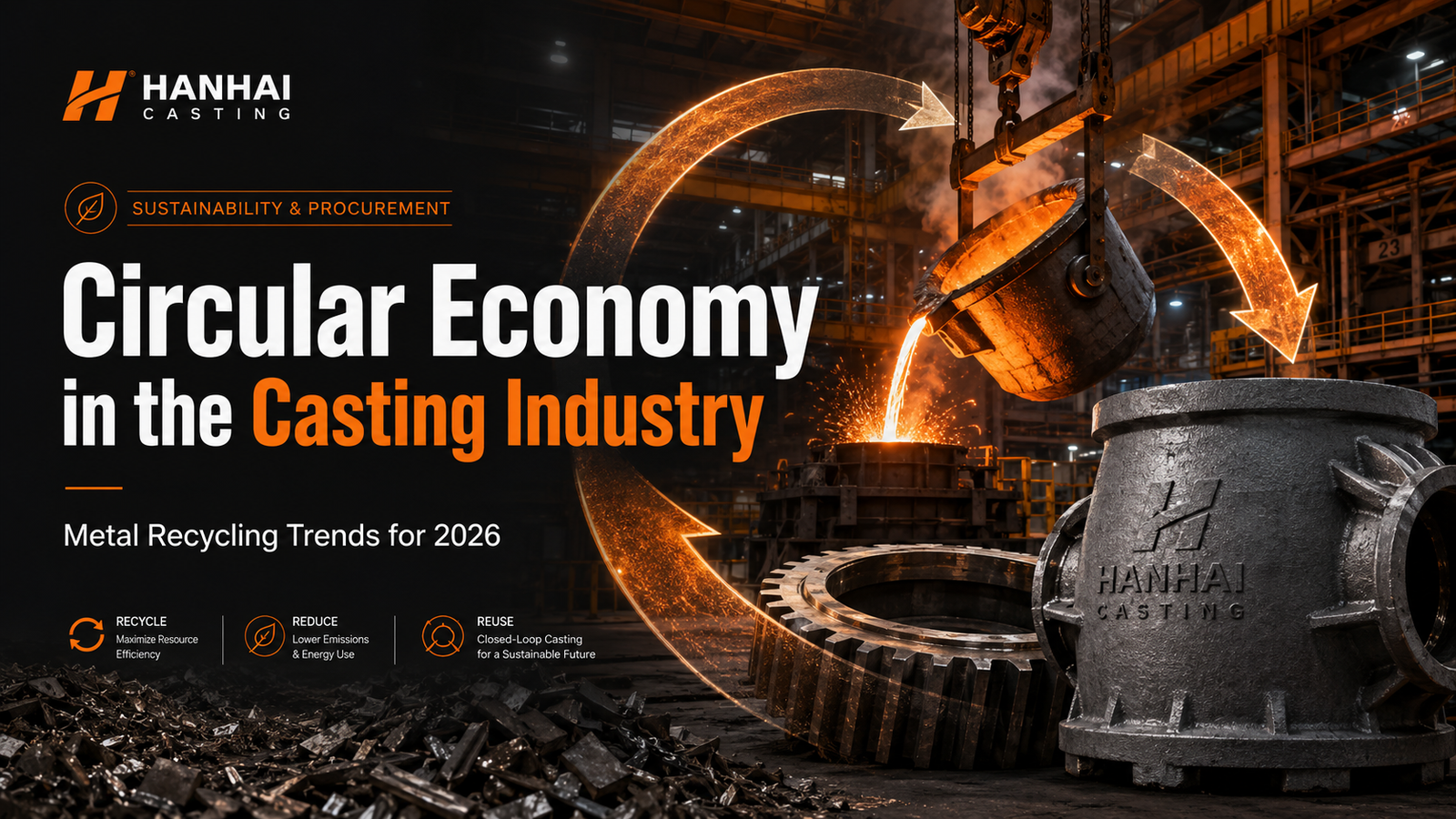
Circular Economy in the Casting Industry is becoming a key strategy for manufacturers seeking to reduce material waste, control production costs, and improve environmental performance. As metal prices, sustainability requirements, and supply chain pressures continue to influence industrial procurement, foundries are increasing the use of recycled metals, improving scrap recovery, and developing more efficient production systems. In 2026, these trends will play an increasingly important role in heavy steel casting, helping manufacturers achieve more sustainable production while maintaining the quality, durability, and reliability required for critical industrial components.
SUSTAINABILITY & PROCUREMENT
CIRCULAR ECONOMY IN THE CASTING INDUSTRY:
METAL RECYCLING TRENDS FOR 2026.
Read Article
Hanhai Engineering Team
July 2, 2026 | 6 MIN READ
CONTENTS
1. Circular Economy in the Casting Industry
Circular Economy in the Casting Industry helps foundries reduce waste, improve resource efficiency, and build more sustainable supply chains. Instead of discarding production scrap, manufacturers recover and reuse suitable metal materials in new casting processes.
Steel, iron, aluminum, and other metals can be remelted and returned to production after sorting and testing. However, recycled materials must still meet strict requirements for chemical composition, strength, wear resistance, and reliability.
1.1 Closed-Loop Metal Production
Closed-loop production returns gates, risers, machining chips, excess metal, and suitable rejected castings to the melting process. This reduces raw material consumption and improves metal utilization.
Before reuse, scrap must be sorted by alloy grade and contamination level. Oil, sand, rust, or mixed alloys can affect casting quality, so careful storage, identification, and testing are essential.
2. Metal Recycling Trends for 2026
In 2026, metal recycling will become more closely connected with digital production, material traceability, and sustainable procurement. Buyers will increasingly evaluate how suppliers recover, test, and document recycled materials.
Circular Economy in the Casting Industry will therefore depend on measurable process control rather than general environmental claims.
2.1 Recycled Steel and Smart Sorting
Foundries are expected to use better sorting systems and digital records to classify recycled steel by alloy composition. Accurate sorting reduces contamination and improves melting consistency.
For heavy steel castings, elements such as carbon, manganese, chromium, nickel, sulfur, and phosphorus must remain within specified limits. Chemical testing and composition adjustment are therefore necessary before pouring.
2.2 Low-Carbon Casting Demand
Industrial buyers are paying greater attention to the environmental impact of casting supply chains. Demand is growing for products made with recycled metals, efficient furnaces, lower material losses, and better resource management.
Longer service life also supports low-carbon manufacturing. Durable castings require fewer replacements, reducing material use, maintenance waste, and equipment downtime.
3. Benefits and Challenges
Circular Economy in the Casting Industry can reduce waste and material costs, but recycled metals must be carefully controlled. Sustainability improvements should never compromise casting quality or performance.
3.1 Lower Waste and Material Costs
Reusing gates, risers, excess metal, and suitable rejected parts reduces the amount of valuable material sent to disposal. It can also lower dependence on newly produced raw materials.
Other benefits include improved metal utilization, lower waste handling costs, better alloy recovery, and greater supply chain stability.
3.2 Quality and Composition Control
Recycled scrap may contain mixed alloys, coatings, rust, oil, or other impurities. Without proper control, these materials can cause porosity, inclusions, composition variations, or reduced mechanical strength.
Reliable foundries use scrap classification, chemical analysis, controlled melting, temperature monitoring, mechanical testing, and nondestructive inspection to maintain stable quality.
4. What Industrial Buyers Should Consider
Buyers should look beyond general claims about recycled content. A casting supplier should clearly explain how metal scrap is inspected, stored, tested, melted, and traced.
Important questions include whether alloy grades are stored separately, chemical composition is tested before pouring, material certificates are available, and production batches can be traced.
At Hanhai Casting, material selection, process control, machining, inspection, and delivery are managed according to customer requirements. Each heavy casting is produced based on its operating conditions, material grade, load, wear, temperature, and expected service life.
5. Conclusion
Circular Economy in the Casting Industry is changing how foundries manage metal resources and production waste. In 2026, recycling will become increasingly connected with smart sorting, traceability, low-carbon procurement, and quality control.
The goal is not simply to use more recycled metal, but to reduce waste while maintaining reliable material properties. For industrial buyers, choosing a supplier with strong testing and traceability can help balance sustainability, cost, quality, and supply security.


 English
 Русский
 العربية
 Español
 Français
 简体中文
简体中文