



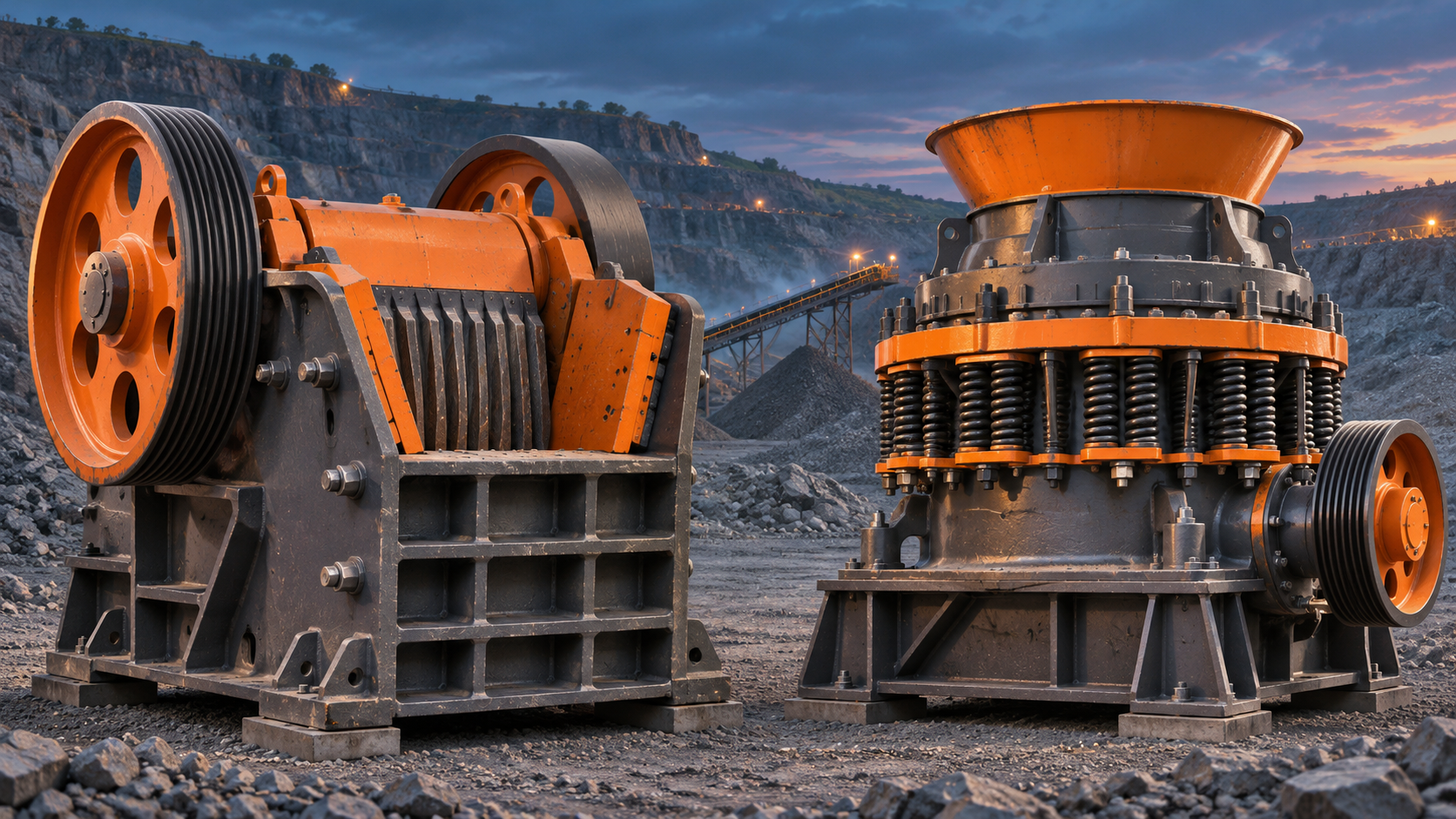
MINING & CRUSHING EQUIPMENT
Jaw Crusher vs. Cone Crusher: Which Is Better for Your Mining Operation?
Choosing the right crushing equipment is essential for improving production efficiency, reducing operating costs, and maintaining stable performance in mining operations.
Jaw crushers and cone crushers are widely used in mining, quarrying, and mineral processing. Although both machines reduce the size of rocks and ores, they have different working principles and applications.
Understanding these differences can help mining operators select suitable equipment for their projects.
1. What Is a Jaw Crusher and How Does It Work?
A jaw crusher is primarily used for the first stage of crushing. It processes large rocks and ores into smaller pieces for further processing.
The machine operates through compression between a fixed jaw plate and a movable jaw plate. As the movable jaw moves, materials are compressed and broken into smaller fragments.
Key advantages include:
- Large feed opening for processing oversized materials.
- Robust structure suitable for demanding mining environments.
- Simple mechanical design and convenient maintenance.
- Reliable performance in primary crushing applications.
Jaw crushers are commonly used for processing granite, limestone, iron ore, and other hard materials. They are generally installed at the beginning of a crushing production line.
2. What Is a Cone Crusher and How Does It Work?
A cone crusher is generally used for secondary and tertiary crushing. It is designed to further reduce the size of materials that have already undergone primary crushing.
The machine operates through the eccentric movement of a mantle inside a stationary concave surface. Materials are continuously compressed until they reach the required discharge size.
Key advantages include:
- Efficient secondary and fine crushing.
- Consistent particle size distribution.
- Suitable for processing hard and abrasive materials.
- Adjustable discharge settings for different production requirements.
Cone crushers are widely used in mining, metallurgy, and aggregate production where controlled material size is important.
3. Key Differences Between Jaw Crushers and Cone Crushers
The main difference between these machines is their role in the crushing process.
Jaw crushers are typically used for primary crushing, while cone crushers are designed for further material reduction.
| Comparison | Jaw Crusher | Cone Crusher |
|---|---|---|
| Crushing stage | Primary crushing | Secondary / Tertiary crushing |
| Feed size | Large materials | Smaller, pre-crushed materials |
| Output size | Relatively coarse | Finer and more controlled |
| Working principle | Jaw plate compression | Mantle and concave compression |
| Maintenance | Relatively simple | More complex |
| Main application | Initial rock crushing | Further size reduction |
Neither machine is universally better. Their suitability depends on the material characteristics and production requirements.
In many mining operations, jaw crushers and cone crushers work together to achieve an efficient crushing process.
4. Performance Comparison: Crushing Capacity, Efficiency, and Maintenance
Equipment performance directly affects the productivity and operating costs of a mining project.
Crushing Capacity
Jaw crushers can process relatively large feed materials, making them suitable for primary crushing. Cone crushers are more effective when processing smaller materials during secondary crushing stages.
Operating Efficiency
Both machines can deliver efficient performance when properly selected and configured. Feed size, material hardness, discharge settings, and equipment capacity all influence crushing efficiency.
Maintenance Requirements
Jaw crushers have a relatively simple structure, with maintenance mainly involving jaw plates, bearings, and lubrication systems.
Cone crushers require regular inspection of the mantle, concave liners, lubrication system, and other critical components.
Operating Costs
When evaluating equipment costs, buyers should consider energy consumption, wear parts, maintenance expenses, and potential downtime rather than focusing only on the initial purchase price.
5. How to Choose the Right Crusher for Your Mining Project
Selecting suitable crushing equipment requires evaluating several important factors.
Material Characteristics
Hardness, abrasiveness, moisture content, and other material properties influence equipment selection and wear resistance requirements.
Feed and Output Size
Jaw crushers are generally suitable for large raw materials, while cone crushers are preferred when finer output sizes are required.
Production Capacity
The selected equipment should meet the project’s required processing capacity and work efficiently with other machines in the production line.
Investment and Maintenance Costs
Equipment pricing, spare parts availability, energy consumption, and maintenance requirements should all be considered.
Production Line Configuration
A typical mining crushing system may include a vibrating feeder, jaw crusher, cone crusher, vibrating screen, and belt conveyors.
Combining these machines appropriately can help improve material processing efficiency and support continuous production.
6. Conclusion: Choosing the Best Crushing Solution for Your Operation
Jaw crushers and cone crushers serve different but complementary functions in mining operations.
Jaw crushers are ideal for primary crushing of large rocks and ores, while cone crushers are more suitable for secondary crushing and producing smaller, more controlled particle sizes.
For many mining projects, combining both machines in a properly designed production line provides an effective solution.
HANHAI supplies mining and mineral processing equipment, including PE Jaw Crushers and PY Spring Cone Crushers, to support different industrial applications.
Whether you are building a new crushing line or upgrading existing equipment, choosing the right machinery is essential for stable production and long-term operational efficiency.
Looking for reliable crushing equipment?
Contact HANHAI to discuss your project requirements, explore suitable equipment solutions, and request a quotation.

 English
 Русский
 العربية
 Español
 Français
 简体中文