



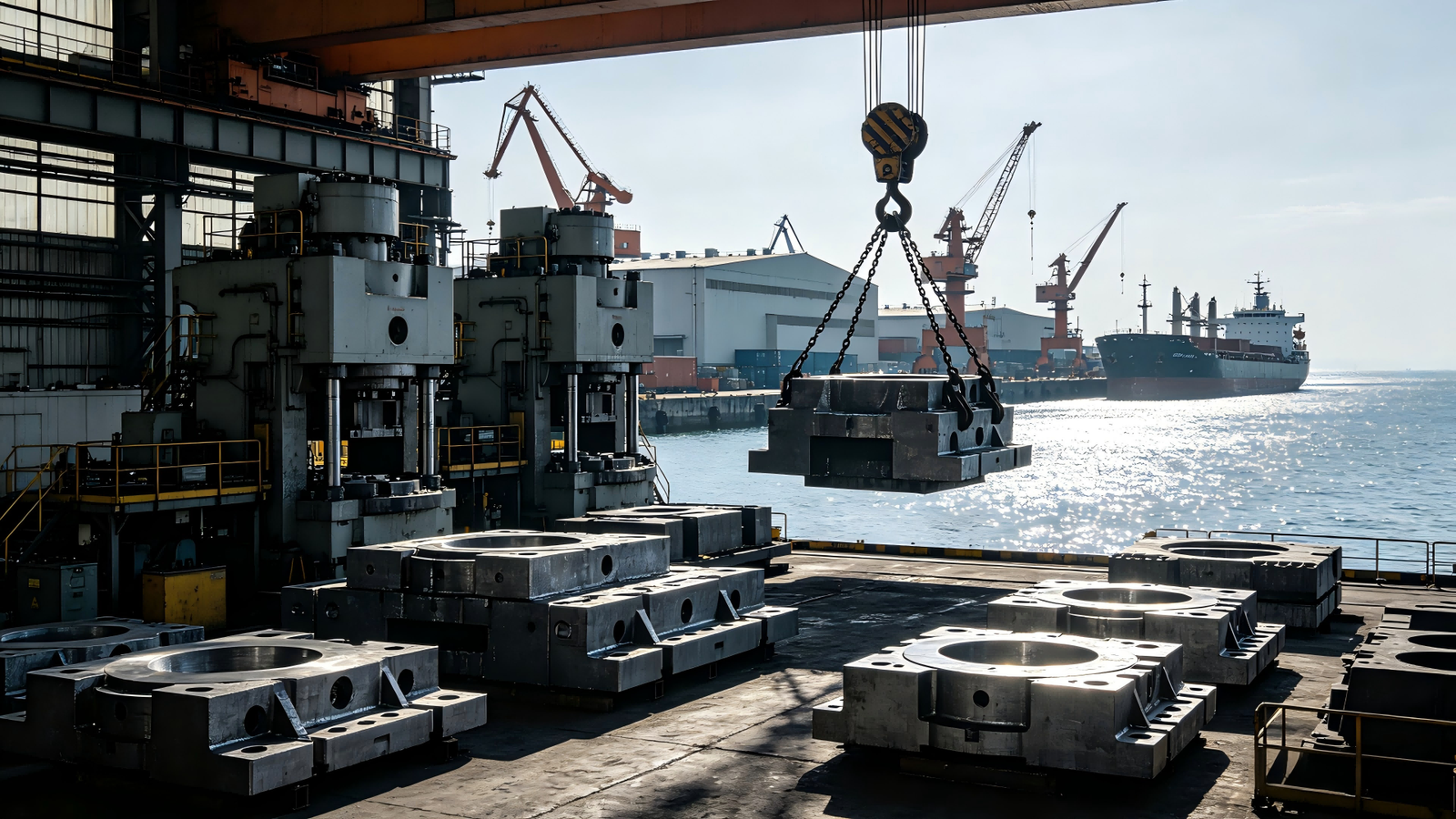
In the competitive landscape of heavy equipment manufacturing, controlling production costs without compromising quality is critical for OEM buyers. When sourcing large industrial components like slag pots or kiln tyres, excessive raw material waste and prolonged CNC machining hours can severely impact your bottom line. This is where near-net shape casting becomes a true game-changer. By producing heavy steel castings that closely match the final precise dimensions right out of the mold, this advanced foundry technique significantly minimizes scrap metal and slashes expensive machining time. Read on to explore how this approach can optimize your supply chain and reduce the Total Cost of Ownership (TCO).
Maximize your foundry ROI by eliminating excess raw materials and slashing expensive CNC production hours.
Hanhai Engineering Team
Apr 10, 2026 · 6 min read
Contents
1. Understanding Near-Net Shape Casting in Heavy Steel Manufacturing
In the context of heavy industrial components, near-net shape casting refers to the advanced process of manufacturing metal parts that are as close to their final, specified dimensions as possible straight out of the mold. Traditionally, producing massive components weighing several tons meant casting a rough shape with excessive dimensional allowances, requiring extensive post-processing. Today, modern foundry technologies allow for incredibly tight tolerances, meaning the "net shape" is almost achieved immediately, bypassing outdated and wasteful traditional methods.
2. Key Ways Near-Net Shape Casting Reduces Total Cost of Ownership (TCO)
For OEM procurement managers, the unit price on a quotation is only part of the equation. Implementing near-net shape casting strategies fundamentally lowers the Total Cost of Ownership (TCO) across the entire manufacturing lifecycle. Here is exactly how this approach saves your budget:
2.1 Drastic Reductions in Raw Material Waste and Scrap
Every millimeter of excess metal on a 10-ton heavy casting represents wasted raw material. By utilizing near-net shape casting, foundries can precisely minimize the pouring weight. This exact volume control means you are not paying for expensive liquid steel or iron that will eventually just be shaved off as scrap metal on the shop floor.
2.2 Slashing CNC Machining Time and Tooling Costs
Heavy steel castings are notoriously tough to machine. When a casting requires minimal stock removal, it drastically reduces the hours spent on 5-axis CNC machines or large gantry milling centers. Furthermore, less heavy cutting means significantly lower wear and tear on expensive carbide cutting tools, translating to direct and immediate cost savings for the OEM buyer.
2.3 Preserving Metallurgical Integrity and Surface Strength
The outer layer of a casting is often the densest and most wear-resistant area due to rapid cooling against the mold wall. Excessive machining removes this protective skin. Near-net shape casting preserves this critical hardened surface, enhancing the structural integrity, durability, and lifespan of components subjected to heavy loads and severe friction.
2.4 Lowering Energy Consumption and Carbon Footprint
Melting fewer tons of unnecessary steel and running heavy CNC equipment for fewer hours directly translates to lower energy consumption. For global buyers aiming to meet strict ESG (Environmental, Social, and Governance) targets, partnering with a foundry that employs near-net shape casting is a proactive step toward a greener, ISO 14001-compliant supply chain.
3. Applications: Where Precision Matters Most for OEM Buyers
The financial and functional benefits of this technology are most evident in heavy-duty industrial sectors where reliability is non-negotiable. At Hanhai Casting, we apply these principles to essential components:
- Metallurgy Equipment: Custom slag pots and ingot molds, where consistent wall thickness is vital for even thermal stress distribution.
- Mining & Cement Equipment: Mill housings, large gear wheels, and kiln tyres, where dimensional accuracy prevents premature wear, vibration, and costly equipment downtime.
4. How Hanhai Casting Achieves Near-Net Shape Precision for Global Clients
Achieving this level of precision on massive 80,000-ton annual production scales requires more than just pouring metal; it requires engineering excellence. At Hanhai Casting, we have perfected the execution of near-net shape casting for heavy industrial parts.
Advanced Pattern Design and Simulation Technology
Before any metal is melted, our engineering team utilizes advanced casting simulation software to predict thermal shrinkage, optimize gating systems, and design patterns with exact allowances. This "digital twin" approach ensures the first pour is right, achieving precise dimensions without the trial-and-error waste of traditional foundries.
Integrated Casting and Machining Solutions
As a comprehensive manufacturer in China, Hanhai Casting offers both high-quality foundry capabilities and state-of-the-art precision machining under one roof. Because we control the entire process from raw material to final testing, we design the casting to perfectly match our machining layout. This seamless integration ensures tighter tolerances, zero communication gaps, and faster on-time delivery for our global partners.

 English
 Русский
 العربية
 Español
 Français
 简体中文
简体中文