
China
Huixian, Henan

service1@hanhaicasting.com
+86 191 0373 1073

ISO 9001 & ISO 14001
Standards for the Mining Industry

Huixian, Henan
+86 191 0373 1073
Standards for the Mining Industry
Engineered for high-capacity secondary and fine crushing, the PFW European Type Impact Crusher delivers excellent particle shaping and stable output performance.
Featuring a heavy-duty rotor, optimized impact plates, and hydraulic adjustment system, it ensures efficient crushing, reduced downtime, and lower operating costs.
Its robust structure and easy maintenance design make it ideal for quarry plants, mining operations, and construction material production lines.

The PFW European Type Impact Crusher is engineered for high-efficiency secondary and fine crushing of medium to hard materials. Utilizing an advanced impact crushing principle, it delivers superior particle shaping and consistent output size for modern aggregate and mining applications.
Featuring a heavy-duty rotor assembly, reinforced impact plates, and hydraulic adjustment systems, the machine ensures stable operation, optimized crushing efficiency, and reduced maintenance downtime. The precision-designed crushing chamber enhances material flow while minimizing excessive fines.
Designed for seamless integration into large-scale crushing lines, the PFW Impact Crusher performs reliably in quarry, mining, and construction material production environments.
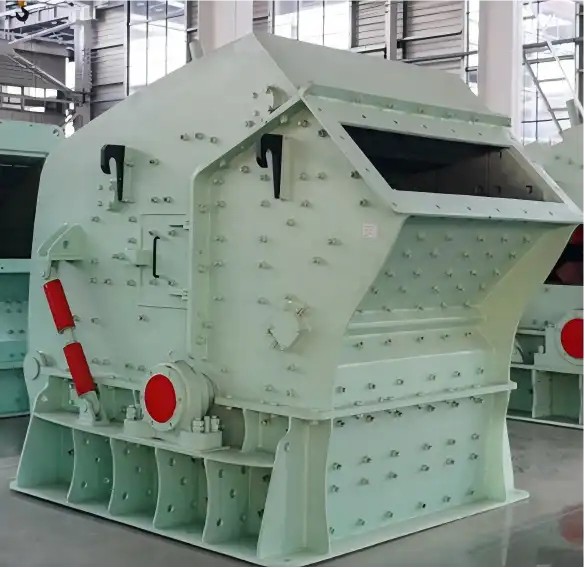
The PFW European Type Impact Crusher operates on an advanced impact crushing principle. Raw material enters the crushing chamber from the top feed inlet and is immediately struck by high-speed rotating blow bars mounted on the rotor.
The material is accelerated and thrown against heavy-duty impact plates, where it is fractured upon impact. Through repeated collisions between the blow bars, impact plates, and materials, the stone is progressively reduced to the required size.
The hydraulic adjustment system allows precise control of the discharge gap, ensuring consistent output size and improved particle shape. Compared to compression-based crushers, the impact crushing process provides higher reduction ratios and superior cubic aggregates.
1. Material Feeding – Material enters the crushing chamber through the top feed opening.
2. High-Speed Impact – The rotor spins at high speed, and blow bars strike the material withstrong impact force.
3. Secondary Impact Crushing – The material is thrown against impact plates and fracturedrepeatedly.
4. Size Control – Adjustable impact plate clearance determines the final discharge size.
5. Discharge & Shaping – Crushed material exits with improved cubicity and uniform grading
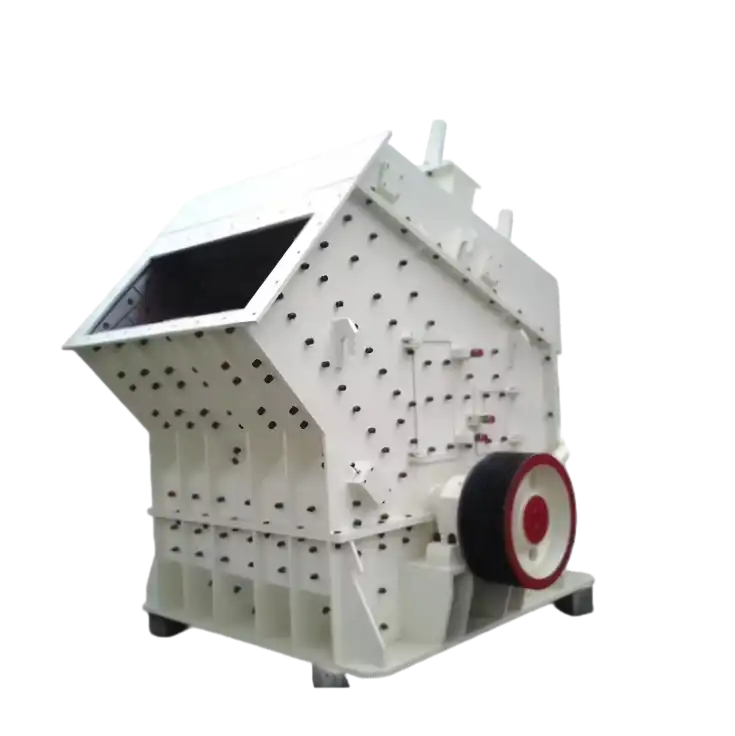
Feeding → High-Speed Impact → Secondary Crushing → Discharge Control → Final Output
| Model | Rotor Size (mm) | Feed Opening Size (mm) | Max Feeding Size (mm) | Capacity (t/h) | Motor Power (kw) | Weight (t) | Overall Dimension (mm) |
|---|---|---|---|---|---|---|---|
| PFW1210Ⅱ | Φ1150×960 | 1100×1030 | 400 | 90-160 | 132-160 | 19 | 2400×1870×2550 |
| PFW1214Ⅱ | Φ1150×1400 | 1100×1430 | 500 | 130-200 | 132-160 | 22 | 2400×2310×2550 |
| PFW1315Ⅱ | Φ1300×1500 | 1200×1500 | 600 | 180-320 | 160-200 | 29 | 2700×2570×2800 |
| PFW1318Ⅱ | Φ1300×1500 | 1200×1500 | 700 | 240-400 | 200-250 | 34 | 2700×2870×2800 |
| PFW1420Ⅱ | Φ1400×1500 | 1200×1430 | 800 | 300-480 | 200-250 | 38 | 2900×2700×2900 |
| PFW1210Ⅲ | Φ1150×960 | 570×990 | 250 | 70-120 | 90-110 | 15 | 2550×2103×2100 |
| PFW1214Ⅲ | Φ1150×1400 | 570×1430 | 250 | 90-160 | 110-132 | 17 | 2550×2310×2100 |
| PFW1315Ⅲ | Φ1300×1500 | 625×1315 | 300 | 100-200 | 160-200 | 25 | 2960×2870×2380 |
| PFW1420Ⅲ | Φ1400×1500 | 800×1530 | 350 | 280-350 | 200-250 | 33 | 3120×2650×2660 |
Customization Options: Our engineering team supports tailored configurations to meet specific project requirements, including optional hydraulic opening systems, upgraded high-chrome blow bars, reinforced impact liners, international-brand motors (ABB, Siemens), and customized voltage standards. Automated lubrication and intelligent monitoring systems are also available upon request.
* Note: Actual production capacity may vary depending on material hardness, moisture content, feed size distribution, and final discharge setting. For accurate performance evaluation, please consult our technical team with detailed material specifications.
• Secondary crushing of limestone, granite, basalt, and concrete
• Aggregate shaping for high-grade construction materials
• Quarry and mining production lines
• Cement and industrial raw material processing
• Medium to hard stone secondary crushing
• Aggregate production with high cubicity requirements
• Infrastructure and road construction material supply
• Large-capacity quarry processing systems
For optimal performance, the PFW European Type Impact Crusher is commonly integrated with:
• Vibrating feeder for stable and continuous material feeding
• Primary jaw crusher for pre-crushing large materials
• Belt conveyor system for efficient material transfer
• Vibrating screen for precise particle size classification
• Optional dust collection system for environmental compliance
Configuration:
Vibrating Feeder → JC Jaw Crusher → PFW Impact Crusher → Vibrating Screen → Belt Conveyor → Stockpile
Recommended for:
Quarry and mining projects requiring secondary crushing with improved aggregate shape and medium-to-large production capacity.
Configuration:
Primary Jaw Crusher → PFW Impact Crusher → Vibrating Screen (Multi-layer) → Sand Making / VSI Crusher (Optional) → Conveyor System
Recommended for:
Construction aggregate production lines requiring high cubicity, controlled particle size, and consistent grading.
Configuration:
Heavy-Duty Feeder → Primary Jaw Crusher → PFW Impact Crusher → Multi-Deck Vibrating Screen → Centralized Conveyor System → Dust Collection System
Recommended for:
Large-scale mining operations demanding stable output, high reduction ratio, and continuous heavy-duty operation.
• Strict quality inspection on critical components including rotor, shaft, and impact plates
• Dynamic balancing test to ensure stable high-speed rotor performance
• High-chrome wear parts for extended durability under heavy-duty operation
• Reinforced welded frame structure for long-term structural stability
• Factory load testing before shipment to verify vibration and output performance
• Technical documentation and remote engineering support for safe installation
Provide your material specifications and production targets.
Our engineers will recommend the most suitable model and configuration within 24–48 hours.
Material Type • Feed Size • Required Capacity • Output Size