
China
Huixian, Henan

service1@hanhaicasting.com
+86 191 0373 1073

ISO 9001 & ISO 14001
Standards for the Mining Industry

Huixian, Henan
+86 191 0373 1073
Standards for the Mining Industry
The PFS Strong Impact Crusher is engineered for maximum performance and durability. Featuring a robust rotor design, heavy-duty blow bars, and a highly optimized crushing chamber, it delivers consistent, high-quality aggregates while minimizing operational costs. Ideal for primary and secondary crushing of medium-hard materials in mining, quarrying, and recycling.
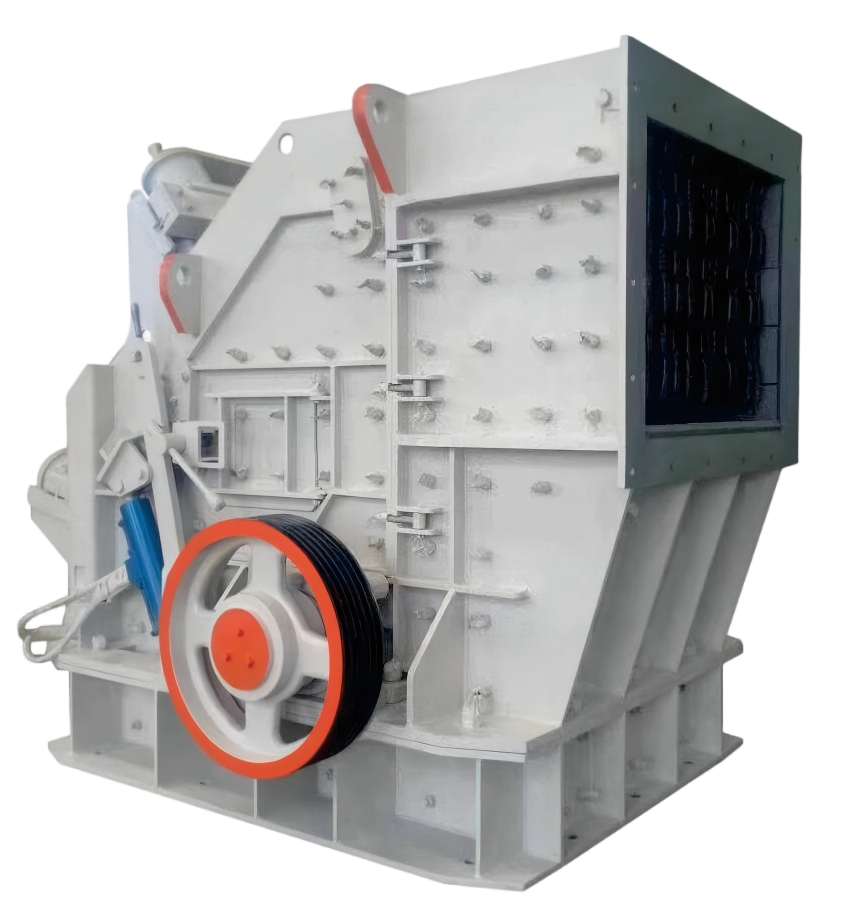
The PFS-Series Strong Impact Crusher is engineered for highly efficient secondary and tertiary crushing of medium-hard materials. Its heavy-duty rotor and powerful impact mechanism ensure a high reduction ratio and an excellent cubical particle shape while minimizing flakiness in the final product.
The hydraulically adjustable impact racks allow for precise output size control, making it highly adaptable for applications requiring strict material grading. The rugged frame structure and high-chrome wear-resistant blow bars ensure stable, continuous performance even under severe industrial conditions.
Designed for seamless integration into comprehensive crushing plants, the PFS Impact Crusher works efficiently with vibrating feeders, belt conveyors, and screening equipment in mining, quarrying, and recycling production lines.
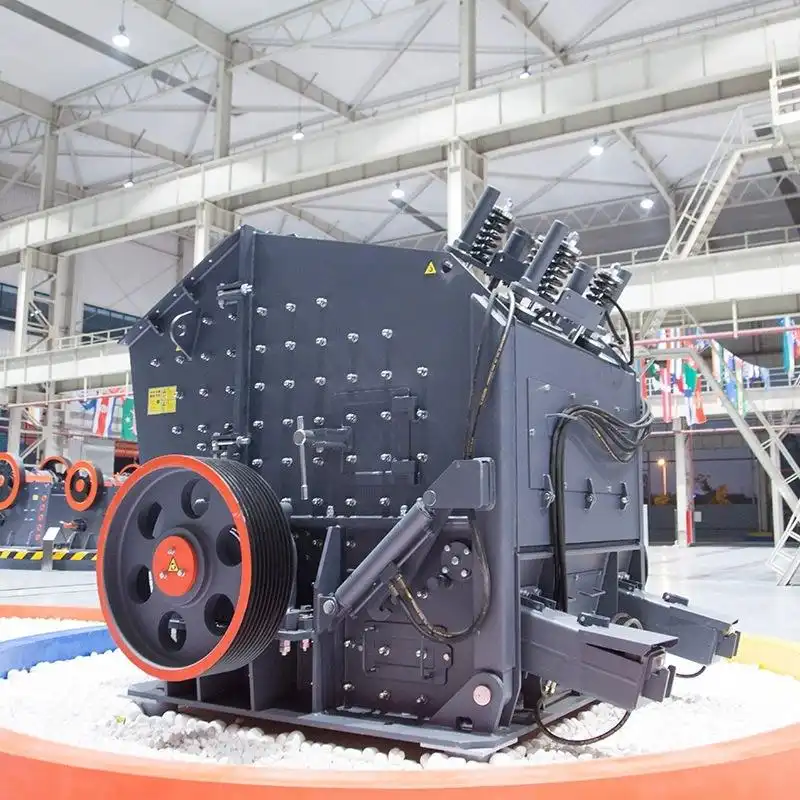
The PFS Impact Crusher utilizes high-energy impact forces to break materials, differing from traditional compression methods. Raw material enters the large feed opening and drops directly into the path of a rapidly spinning rotor.
Heavy-duty blow bars mounted on the rotor violently strike the material, shattering it instantly. The crushed fragments are then propelled upward at high velocity against rugged impact aprons (racks) suspended in the upper chamber.
Material rebounds from the impact plates back towards the rotor for repeated crushing. This continuous cycle of impact and inter-particle collision ensures a highly uniform, cubical final product. The clearance between the impact aprons and rotor can be easily adjusted to control the final discharge size.
1. Material Feeding Bulk material drops into the crushing chamber via the top feedopening.
2. Rotor Impact – High-speed blow bars strike the falling material, delivering the primarycrushing force.
3. Rebound Fragmentation Material is forcefully thrown against heavy-duty impactaprons for secondary crushing.
4. Size Adjustment The adjustable gap between the rotor and impact plates preciselydictates the maximum product size.
5. Continuous Discharge – Properly sized, cubical particles exit smoothly through thebottom discharge opening.
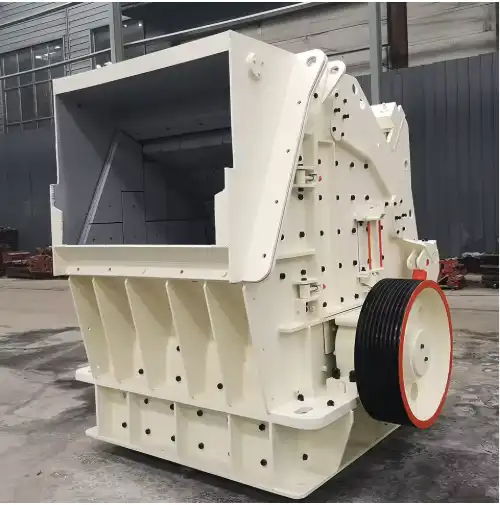
Material Feeding → Rotor Impact → Rebound Crushing → Size Control → Continuous Discharge
| Model | Adjustable Range of Outlet (mm) | Max Feeding Size (mm) | Capacity (t/h) | Motor Power (kw) | Overall Dimension (mm) |
|---|---|---|---|---|---|
| PFS1010 | 20-100 | 600 | 100-200 | 90-110 | 2800 × 1925 × 2305 |
| PFS1210 | 20-100 | 900 | 140-285 | 110-160 | 2871 × 1967 × 2600 |
| PFS1214 | 20-100 | 900 | 200-400 | 160-200 | 2871 × 2307 × 2600 |
| PFS1317 | 20-200 | 950 | 250-500 | 200-315 | 3175 × 2781 × 2800 |
| PFS1420 | 20-200 | 1000 | 400-600 | 315-375 | 3582 × 3205 × 3118 |
| PFS1620 | 20-200 | 1200 | 550-700 | 400-500 | 4056 × 3395 × 3356 |
Customization Options: Our engineering team can accommodate specific operational requirements, including custom IEC/NEMA motor brands (ABB, Siemens), specialized high-chrome blow bars and heavy-duty impact liners, localized voltage standards, and advanced hydraulic gap adjustment and automated casing opening systems.
* Note: Final capacity and production parameters depend on the specific material’s compressive strength, bulk density, maximum feed size, moisture content, and the required rotor speed and gap settings.
Exceptional Particle Shape: Produces high-quality, perfectly cubical aggregates with minimal flakiness, ideal for premium construction projects.
High Reduction Ratio: Powerful dynamic impact crushing allows for highly efficient secondary and tertiary size reduction.
Durable Wear Parts: Heavy-duty rotor and high-chrome blow bars significantly extend the service life in demanding environments.
Easy Maintenance: Equipped with a hydraulic casing opening system for safe, rapid inspection and wear part replacement.
Secondary crushing of medium-hard materials like limestone, concrete, and dolomite.
High-grade aggregate production for highway, railway, and commercial construction.
Construction and demolition (C&D) waste recycling and processing.
Processing non-abrasive industrial minerals and ores in mining operations.
Vibrating feeder for regulated, continuous material feeding.
Belt conveyors for smooth material transport and discharge handling.
Vibrating screen for precise, closed-circuit particle size classification.
Dust collection system to minimize emissions and ensure environmental compliance.
Configuration: Vibrating Feeder → Jaw Crusher (Primary) → PFS Impact Crusher (Secondary) → Vibrating Screen
Description: Ideal for medium-hard stone quarrying, producing high-quality, perfectly shaped aggregates for standard construction needs.
Configuration: Feeder → Jaw Crusher → PFS Impact Crusher ↔ Vibrating Screen (Oversize material returns to impactor)
Description: Recommended for strict aggregate size requirements, ensuring 100% of the final product meets exact grading specifications.
Configuration: Feeder → Magnetic Separator → PFS Impact Crusher → Vibrating Screen
Description: Optimized for crushing concrete and asphalt rubble, effectively separating rebar and producing reusable recycled materials.
1. ISO 9001 Certified Manufacturing: All PFS-series crushers are manufactured under strict ISO quality control standards, ensuring every component meets high-precision industrial tolerances.
2. Heavy-Duty Structural Integrity: The crusher frame is constructed from high-strength, stress-relieved welded steel to withstand extreme impact loads and prevent long-term structural fatigue.
3. Advanced Hydraulic Safety System: Equipped with a hydraulic casing opening system and mechanical safety interlocks, providing secure and effortless access for internal inspection and maintenance.
Provide your material specifications and production targets.
Our engineers will recommend the most suitable model and configuration within 24–48 hours.
Material Type • Feed Size • Required Capacity • Output Size