



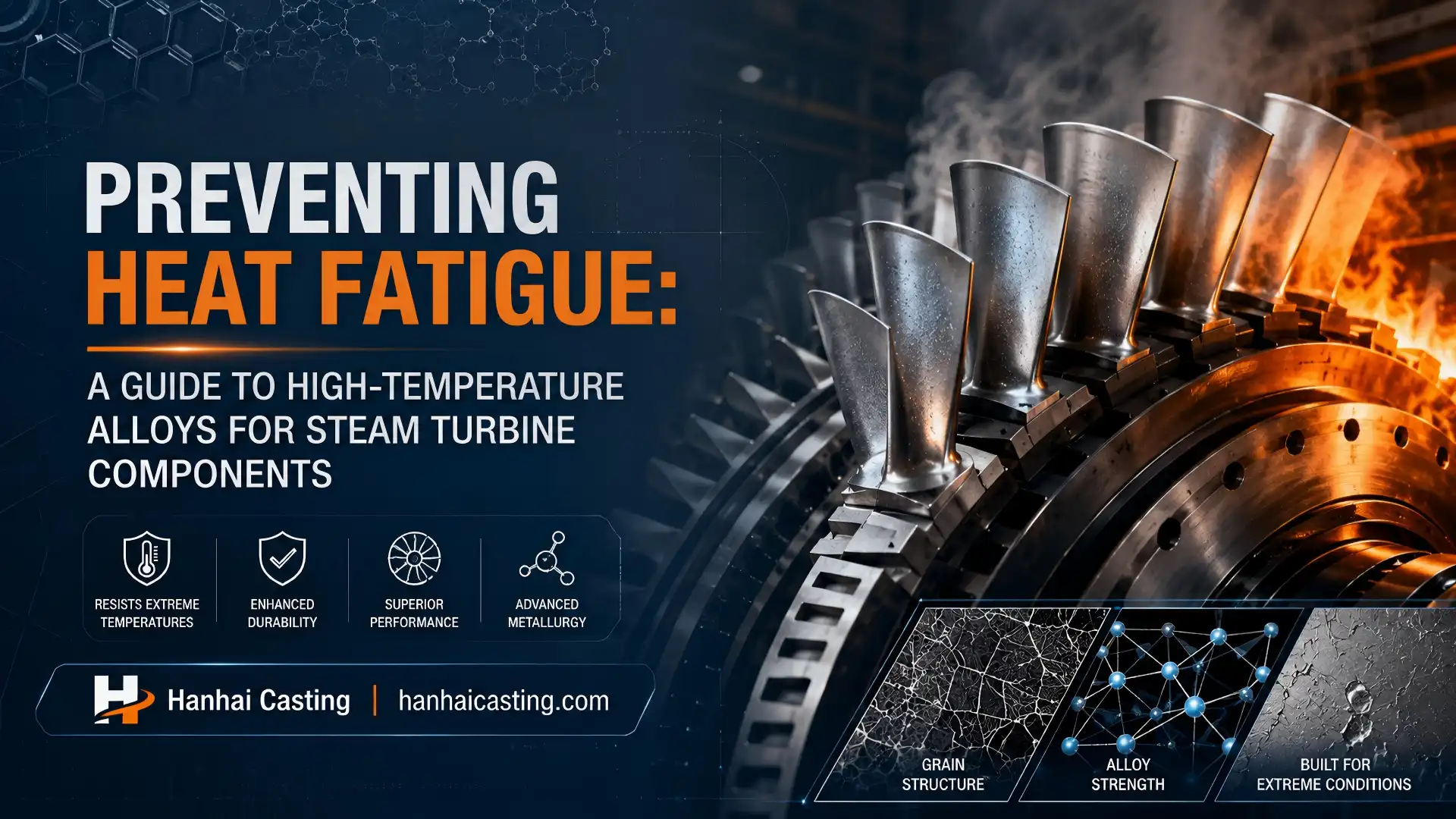
In the demanding world of power generation, steam turbine components face extreme thermal cycling and relentless pressure. For OEM engineers, preventing catastrophic heat fatigue and ensuring long-term operational stability are top priorities. The key to solving these challenges lies at the very beginning of the manufacturing process: material selection. In this comprehensive guide, we explore how choosing the correct high-temperature alloys for your heavy steel castings can drastically extend component lifespan, enhance turbine efficiency, and ultimately reduce total cost of ownership.
POWER GENERATION & METALLURGY
HOW STRATEGIC MATERIAL SELECTION
EXTENDS COMPONENT LIFE & PREVENTS FAILURES
IN HEAVY POWER GENERATION EQUIPMENT.
Read Article
Hanhai Engineering Team
May 6, 2026 | 6 MIN READ
CONTENTS
- 1. Understanding Heat Fatigue in Steam Turbine Components
- 2. The Crucial Role of High-Temperature Alloys in Heavy Castings
- 3. Top High-Temperature Alloys for Steam Turbine Castings
- 4. Overcoming Foundry Challenges When Casting High-Temperature Alloys
- 5. Partnering with HanHai Casting for Reliable Steam Turbine Components
1. Understanding Heat Fatigue in Steam Turbine Components
In the heavy machinery sector, power generation equipment operates under some of the most unforgiving conditions on the planet. For steam turbines, the continuous operation creates a highly volatile internal environment where components are constantly stressed. Understanding how these parts fail is the first step toward building better ones.
1.1 The Impact of Thermal Cycling and Creep
Steam turbine castings endure a relentless cycle of rapid heating and cooling known as thermal cycling. Over time, this constant expansion and contraction causes micro-cracks to form within the metal's structure—a phenomenon known as heat fatigue. Coupled with this is "creep," the slow, progressive deformation of a material under constant stress at elevated temperatures. If not properly addressed at the manufacturing stage, heat fatigue and creep will inevitably lead to component failure and unplanned downtime.
1.2 Why Standard Carbon Steels Fall Short in Power Generation
While standard carbon steels are excellent for general industrial use, they quickly degrade in a steam turbine's environment. At extreme operating temperatures, standard steel loses its tensile strength, becomes highly susceptible to oxidation, and scales rapidly. To maintain structural integrity over a 20- or 30-year lifecycle, OEM engineers must look beyond basic carbon structures and specify advanced materials.
2. The Crucial Role of High-Temperature Alloys in Heavy Castings
To combat the destructive forces of heat fatigue and high-pressure steam, foundries rely on specialized metallurgy. This is where high-temperature alloys become indispensable. By carefully manipulating the chemical composition of the steel, manufacturers can engineer castings that thrive exactly where standard materials fail.
2.1 Key Material Properties: Creep Resistance and Oxidation Resistance
The defining characteristics of high-temperature alloys are their exceptional creep resistance and oxidation resistance. Alloying elements like chromium, molybdenum, and vanadium are introduced to stabilize the steel's microstructure. Chromium provides a vital protective layer against surface oxidation and corrosion, while molybdenum and vanadium significantly enhance the metal's ability to resist creep at red-hot temperatures, ensuring the casting retains its precise dimensional tolerances.
2.2 How High-Temperature Alloys Reduce Total Cost of Ownership (TCO)
For procurement managers, the initial cost of high-temperature alloys is naturally higher than standard steel. However, the true value becomes apparent in the Total Cost of Ownership (TCO). By preventing premature heat fatigue, these advanced materials drastically extend the maintenance cycles of the steam turbine. Reducing just one unscheduled shutdown or delaying a major component replacement easily offsets the initial investment in premium metal casting.
3. Top High-Temperature Alloys for Steam Turbine Castings
Choosing the correct grade depends heavily on the specific operating zone within the turbine. Here are the most common high-temperature alloys utilized for heavy OEM castings:
3.1 Chromium-Molybdenum-Vanadium (Cr-Mo-V) Steels: The Industry Standard
For major components like turbine casings, valve bodies, and steam chests, Cr-Mo-V steels (such as ASTM A217 grades WC6 and WC9) are the industry standard. These materials offer an excellent balance of castability, weldability, and long-term thermal stability, making them the go-to choice for the backbone of the turbine.
3.2 Advanced Austenitic Stainless Steels for High-Corrosion Zones
In areas where both extreme heat and high corrosion are present, austenitic stainless steels are heavily favored. The high nickel and chromium content in these high-temperature alloys prevents the scaling and pitting that can compromise the aerodynamic efficiency of the turbine's internal flow paths.
3.3 Nickel-Based Superalloys for Extreme Temperature Limits
While more commonly associated with gas turbines, certain extreme-duty steam applications are beginning to incorporate nickel-based superalloys. These materials push the boundaries of metallurgy, maintaining structural integrity at temperatures that would cause standard alloys to physically melt.
4. Overcoming Foundry Challenges When Casting High-Temperature Alloys
Designing the part is only half the battle; manufacturing it requires an experienced foundry. High-temperature alloys are notoriously difficult to cast due to their complex flow characteristics and high pouring temperatures.
4.1 Managing Porosity and Shrinkage in Heavy Steel Castings
Because these specialized alloys often have a narrow freezing range, they are highly prone to internal shrinkage and porosity. At HanHai Casting, we utilize advanced casting simulation software to design optimized gating and riser systems. This ensures directional solidification, guaranteeing a dense, defect-free internal structure that can withstand the extreme pressures of power generation.
4.2 Precision Heat Treatment Process for Maximizing Material Strength
A raw casting has not yet reached its full potential. To truly activate the mechanical properties of high-temperature alloys, a rigorous and highly controlled heat treatment process is required. Through precise normalizing, quenching, and tempering cycles, we align the material's microstructure, locking in the maximum creep resistance and toughness required to prevent heat fatigue.
5. Partnering with HanHai Casting for Reliable Steam Turbine Components
Preventing heat fatigue starts with choosing a foundry that understands the complex metallurgy of power generation. At HanHai Casting, we specialize in the casting and CNC machining of heavy steel components for global OEM buyers.
With our strict adherence to international material standards (ASTM, DIN, ISO) and rigorous non-destructive testing (NDT) protocols, we ensure that every turbine component we produce meets your exact performance specifications.

 English
 Русский
 العربية
 Español
 Français
 简体中文
简体中文