



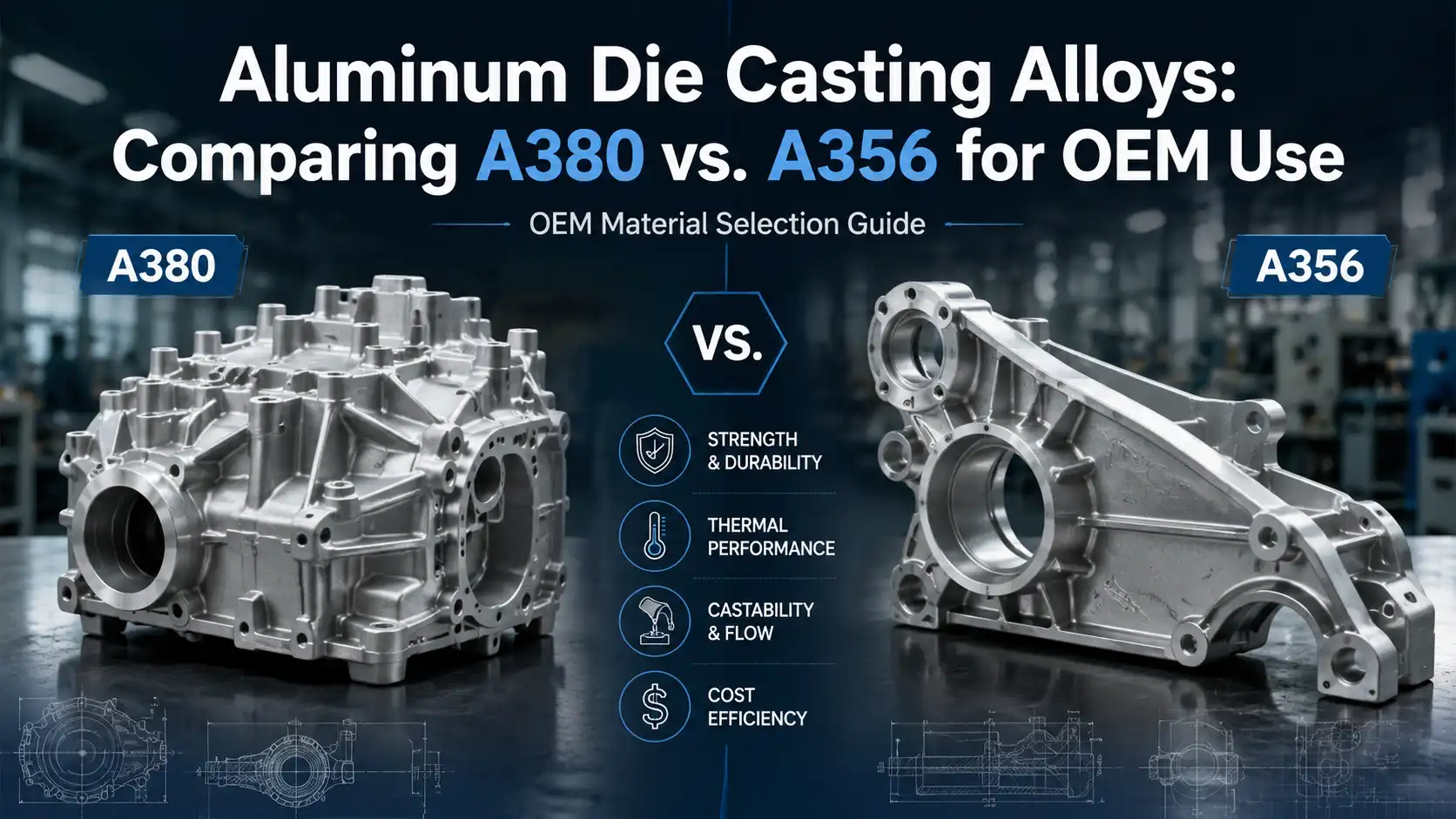
For OEM manufacturers, selecting the right material is crucial for balancing part performance and production costs. When it comes to lightweight and durable components, the decision often comes down to A380 vs. A356. While both are highly versatile aluminum die casting alloys, they possess distinct mechanical properties, castability, and ideal applications. In this comprehensive guide, Hanhai Casting breaks down the critical differences between these two materials to help you choose the perfect alloy for your next industrial project.
A COMPREHENSIVE GUIDE TO BALANCING
STRENGTH, COST, AND CASTABILITY
FOR YOUR NEXT INDUSTRIAL MANUFACTURING PROJECT.
Read Article
Hanhai Engineering Team
May 9, 2026 | 6 MIN READ
CONTENTS
- 1. Understanding the Basics: A380 and A356 Aluminum Alloys
- 2. Key Differences: A380 vs. A356 Explained
- 3. Quick Comparison Chart
- 4. Cost Analysis: Which Alloy is More Cost-Effective for OEMs?
- 5. Typical OEM Applications for A380 and A356
- 6. How to Choose the Right Aluminum Die Casting Alloy
- 7. Partner with Hanhai Casting for Your Aluminum Die Casting Needs
1. Understanding the Basics: A380 and A356 Aluminum Alloys
For OEM manufacturers, selecting the right material is crucial for balancing part performance and production costs. When it comes to lightweight and durable components, the decision often comes down to A380 vs. A356. While both are highly versatile aluminum die casting alloys, they possess distinct mechanical properties, castability, and ideal applications.
1.1 What is A380 Aluminum Alloy?
A380 is arguably the most widely used aluminum die casting alloy in the world. Belonging to the 380 series, it offers an exceptional balance of material properties and manufacturability. It contains a higher percentage of silicon and copper, which gives it outstanding fluidity when molten. This makes A380 the go-to choice for complex, thin-walled, and intricate OEM parts. It is highly valued for its pressure tightness, excellent resistance to hot tearing, and overall cost-effectiveness.
1.2 What is A356 Aluminum Alloy?
A356 (and its close relative A356.2) is a premium, high-strength aluminum alloy. While it is historically popular in sand and permanent mold casting, it is increasingly used in high-integrity, structural die casting (such as vacuum die casting). It features high silicon but very low copper content. What sets A356 apart is its excellent ductility and its ability to be heat-treated (specifically the T6 temper), which significantly enhances its mechanical strength and impact resistance.
2. Key Differences: A380 vs. A356 Explained
To make an informed engineering decision, OEMs must understand the technical distinctions between these two materials. Here is how A380 vs. A356 compare across critical manufacturing metrics.
2.1 Mechanical Properties and Strength
While A380 provides a solid baseline of strength and rigidity suitable for most commercial applications, A356 is engineered for structural integrity. When A356 undergoes T6 heat treatment, its tensile strength and yield strength increase dramatically. More importantly, A356 offers superior elongation (ductility), meaning it will bend or deform under extreme stress rather than cracking or shattering like the more brittle A380.
2.2 Castability and Machinability
If your OEM part has complex geometries or very thin walls, A380 is the winner. Its high silicon content ensures unmatched fluidity, filling complex die cavities effortlessly and reducing casting defects. A356 also has good castability but is slightly less fluid. However, when it comes to CNC machining after casting, A356 takes the lead. It produces cleaner chips and allows for tighter tolerances during secondary machining processes.
2.3 Corrosion Resistance and Surface Finishing
Due to its higher copper content (typically 3-4%), A380 has moderate corrosion resistance and is generally not recommended for harsh outdoor or marine environments unless treated with a protective coating. In contrast, the extremely low copper content in A356 gives it exceptional natural corrosion resistance. Furthermore, A356 takes to anodizing beautifully, allowing for high-quality, aesthetic surface finishes that A380 cannot easily achieve.
3. Quick Comparison Chart
Use the table below for a quick technical reference:
| Feature / Specification | A380 Aluminum | A356 Aluminum (T6 Treated) |
|---|---|---|
| Primary Advantage | Excellent castability & low cost | High strength & ductility |
| Copper (Cu) Content | 3.0% - 4.0% | < 0.20% |
| Tensile Strength | ~324 MPa (47,000 psi) | ~276+ MPa (40,000+ psi) |
| Elongation (Ductility) | 3% | 6% - 8% |
| Corrosion Resistance | Moderate | Excellent |
| Heat Treatable? | No | Yes (Highly recommended) |
4. Cost Analysis: Which Alloy is More Cost-Effective for OEMs?
When evaluating A380 vs. A356 from a procurement perspective, Total Cost of Ownership (TCO) is a major factor.
Generally, A380 is the more cost-effective option. Its raw material price is typically lower, and its excellent fluidity means faster cycle times, lower rejection rates, and reduced wear and tear on die casting molds.
A356 is considered a premium material. Not only is the base alloy slightly more expensive, but achieving its maximum potential requires secondary T6 heat treatment, which adds to the overall lead time and unit cost. However, for parts where failure is not an option (such as automotive safety components), the higher cost of A356 is a necessary and justified investment.
5. Typical OEM Applications for A380 and A356
Choosing the right material often comes down to the end-use environment of the part. The battle of A380 vs. A356 is easily resolved when you look at industry standards.
5.1 When to Choose A380 for Your Projects
Opt for A380 when you need high-volume production of complex parts where extreme structural stress is not a primary concern. Typical applications include:
- Electronic equipment housings and heat sinks
- Gearboxes and engine brackets
- Power tool housings and hand tools
- General household appliance components
- Brackets, pumps, and valves
5.2 When to Choose A356 for High-Performance Parts
Select A356 when your components will face heavy structural loads, impact, or corrosive environments. Typical applications include:
- Automotive chassis and suspension parts
- Structural aerospace components
- Marine hardware and fittings
- High-pressure hydraulic cylinders
- Wheels and structural safety nodes
6. How to Choose the Right Aluminum Die Casting Alloy
Resolving the A380 vs. A356 debate for your specific project requires a simple checklist. Ask your engineering team the following questions:
- Is the part load-bearing? If yes, choose A356.
- Are you producing a high-volume, thin-walled housing? If yes, A380 is your best bet.
- Will the part be exposed to saltwater or harsh weather? A356 offers superior corrosion resistance.
- Is budget the primary constraint? A380 will keep your manufacturing costs lower.
7. Partner with Hanhai Casting for Your Aluminum Die Casting Needs
At Hanhai Casting, we understand that material selection is the foundation of a successful manufacturing project. Whether you require the cost-effective complexity of A380 or the structural superiority of A356, our engineering team is here to guide you.
We offer integrated solutions, from mold design and high-pressure die casting to precision 5-axis CNC machining and surface finishing. By partnering with us, OEMs can guarantee consistent quality, optimized costs, and on-time delivery.
Ready to start your next project? Contact Hanhai Casting today and send us your drawings to request a free, detailed quote.

 English
 Русский
 العربية
 Español
 Français
 简体中文
简体中文