


为氢能基础设施制造关键重型铸件

用于氢基础设施的重型铸件

As the global shift toward clean energy accelerates, the demand for reliable fluid handling and high-pressure storage components has reached unprecedented levels. Achieving long-term durability in these extreme environments requires specialized engineering expertise. This guide explores the critical role of custom heavy castings for hydrogen infrastructure, analyzing the metallurgical standards, non-destructive testing (NDT) protocols, and material selections necessary to prevent catastrophic failure and ensure system integrity.

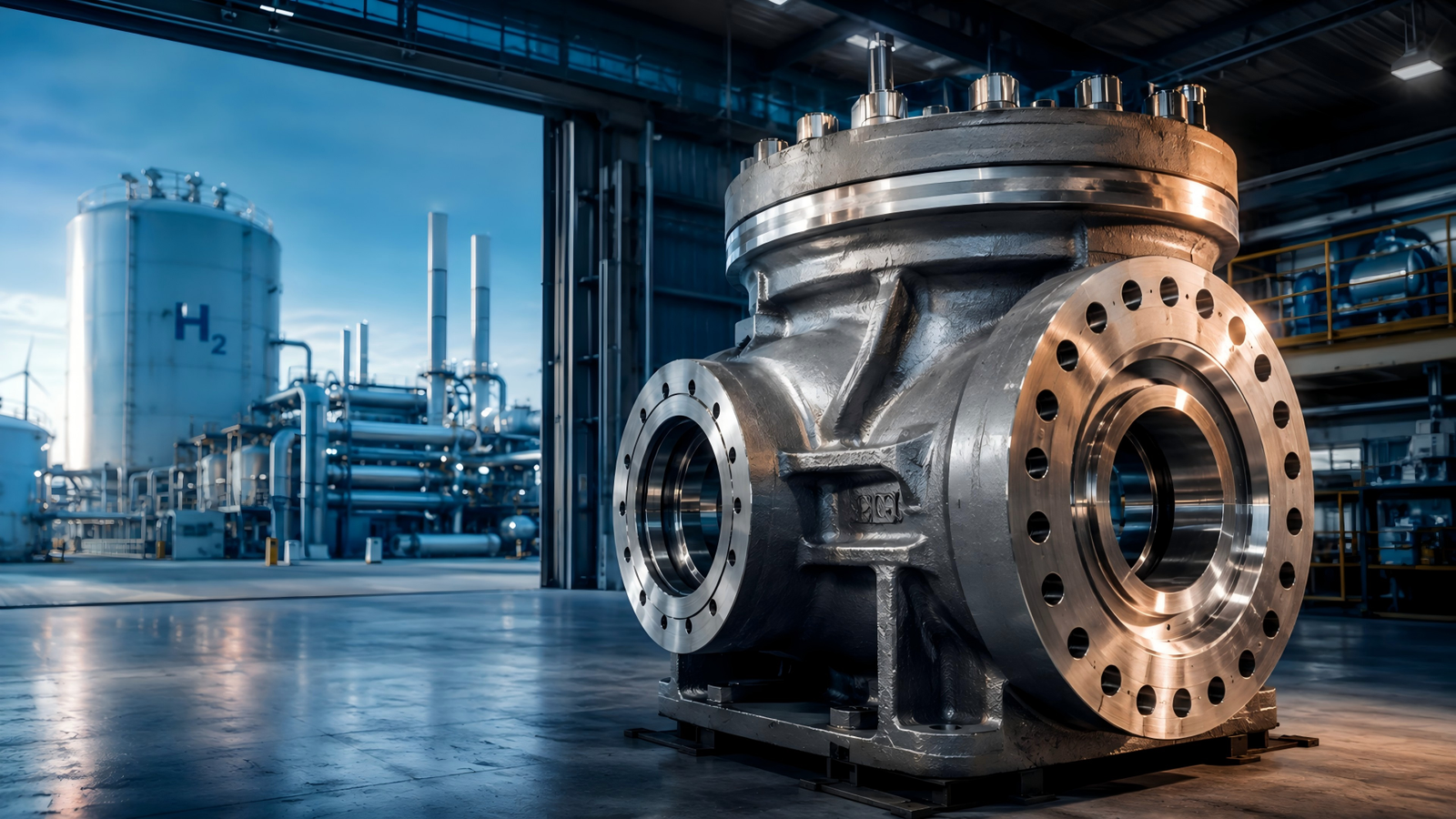
Hydrogen Infrastructure Heavy Castings - Hanhai Casting

HYDROGEN SOURCING & METALLURGY

MANUFACTURING CRITICAL HEAVY CASTINGS
FOR HYDROGEN INFRASTRUCTURE

阅读文章

瀚海工程团队

June 1, 2026  |  7 MIN READ

1. The Role of Heavy Castings for Hydrogen Infrastructure

The global transition to a net-zero carbon economy has placed immense pressure on green energy supply chains. As hydrogen emerges as a cornerstone of clean energy, industrial systems must scale up to handle unprecedented volumes of this volatile gas. In this rapid expansion, the demand for heavy castings for hydrogen infrastructure has grown significantly, serving as the foundational structural components for large-scale compression, storage, and transport systems.

1.1 High-Pressure Containment Challenges in Hydrogen Systems

Unlike natural gas or liquid petroleum, hydrogen molecules are extremely small and highly diffusive. When stored or transported at typical industrial pressures—often exceeding 350 to 700 bar—hydrogen can easily find microscopic pathways to escape. Managing these high-pressure containment demands requires massive, thick-walled housings for compressors, valves, and manifolds that can withstand cyclic loading without losing structural integrity or allowing gas leakage.

1.2 Why Forgings and Fabrications Fall Short for Complex Geometries

While multi-piece welded fabrications and heavy forgings are traditional alternatives, they introduce significant risks in hydrogen environments. Welded joints are notorious for creating heat-affected zones (HAZ) that are highly susceptible to micro-cracking and localized stress concentration. Furthermore, complex internal geometries—such as those found in multi-stage compressor blocks or intricate valve manifolds—are nearly impossible to forge cost-effectively. Custom heavy castings for hydrogen infrastructure solve these limitations by providing a monolithic, single-piece component that eliminates weld-related failure points and optimizes fluid dynamics through complex internal channels.

2. Critical Metallurgical Selection: Preventing Hydrogen Embrittlement

The greatest technical hurdle in manufacturing components for hydrogen service is hydrogen embrittlement. This phenomenon occurs when atomic hydrogen diffuses into the crystalline lattice of a metal, causing sub-critical crack growth, reduced ductility, and sudden, catastrophic structural failure under stress.

2.1 Evaluating ASTM and ISO Steel Alloys for Hydrogen Service

To mitigate this risk, procurement teams must carefully verify material specifications. For heavy-duty components, specific ASTM standards—such as ASTM A351 for austenitic stainless steels or specialized grades of ASTM A216/A352 for low-alloy carbon steels—are standard benchmarks. The chosen alloys must exhibit high fracture toughness and low hydrogen diffusivity to ensure that the material retains its mechanical properties over decades of continuous exposure.

2.2 The Importance of Low-Carbon and Austenitic Microstructures

The microstructure of the cast steel plays a definitive role in its resistance to degradation. Austenitic stainless steels (such as 316L or CF8M) are highly preferred because their face-centered cubic (FCC) crystal structure offers a significantly lower hydrogen diffusion rate compared to ferritic steels. When using low-alloy carbon steels for massive structural bases, keeping carbon equivalents low and enforcing strict post-cast heat treatments (such as normalizing and tempering) is mandatory to refine the grain structure, relieve residual stresses, and minimize hard martensitic phases that invite embrittlement.

3. Key Manufacturing Processes for Large-Scale Energy Components

Producing high-integrity heavy castings for hydrogen infrastructure requires specialized foundry engineering that bridges the gap between massive scale and microscopic precision.

3.1 Advanced Sand Casting Techniques for Flawless Cast Integrity

At the foundry level, achieving a defect-free casting begins with advanced sand molding technologies, such as resin-bonded furan sand systems. This method provides exceptional mold stability and surface finish, reducing the risk of sand inclusions or gas porosity. Advanced solidification simulation software is utilized before pouring, allowing engineers to strategically place risers and chills to ensure directional solidification. This eliminates shrinkage cavities in the heaviest cross-sections of the casting.

3.2 Precision CNC Machining for Tight Tolerances in Valve and Pump Housings

A heavy casting is only as good as its final machined interfaces. Large-scale components like hydrogen pump casings require massive 5-axis CNC machining centers to process critical sealing surfaces, O-ring grooves, and flanged connections. Maintaining tight tolerances is not just about assembly fit; it is a critical safety requirement. Perfect flatness and precise surface roughness (Ra values) ensure that high-pressure, hydrogen-rated gaskets seat flawlessly to prevent fugitive emissions.

4. Quality Assurance & NDT Standards for Clean Energy Castings

In high-consequence energy infrastructure, material defects are unacceptable. Heavy industrial foundries must implement rigorous, multi-layered quality control protocols to validate internal and external casting soundness.

4.1 Radiographic (RT) and Ultrasonic (UT) Testing for Subsurface Defects

Non-Destructive Testing (NDT) is the backbone of quality assurance for renewable energy components. For thick-walled heavy castings for hydrogen infrastructure, ultrasonic testing (UT) according to ASTM A609 is essential to detect deep-seated internal defects, volumetric shrinkage, or voids. For critical intersection points and valve gates, high-energy radiographic testing (RT) or digital radiography provides a clear visual map of the internal microstructure, ensuring compliance with specified severity levels. Additionally, Magnetic Particle Testing (MT) or Liquid Penetrant Testing (PT) is deployed to catch surface micro-fissures.

4.2 Hydrostatic and Pressure Testing Compliance

Before any heavy casting leaves the factory floor, it must undergo strict hydrostatic or gas pressure testing. Components are pressurized to a minimum of 1.5 times their rated maximum allowable working pressure (MAWP). This live test serves as the ultimate validation of the casting’s structural integrity and the foundry's manufacturing quality under simulated field conditions.

5. Sourcing OEM Heavy Castings for Hydrogen Infrastructure

As the market for hydrogen equipment matures, global original equipment manufacturers (OEMs) must balance stringent technical compliance with commercial viability when building their supply chains.

5.1 Total Cost of Ownership (TCO) in Long-Term Energy Projects

When evaluating quotes for heavy metal castings, focusing solely on the initial per-kilogram price often leads to hidden costs down the line. A cheaper casting that suffers from poor weldability, high rejection rates during final machining, or premature field failure vastly inflates the Total Cost of Ownership (TCO). Investing in high-quality, near-net-shape castings from an experienced foundry drastically reduces machining hours, material waste, and downstream warranty risks.

5.2 Evaluating Chinese Foundry Capabilities for Renewable Energy Compliance

For industrial buyers seeking to scale production, top-tier Chinese casting manufacturers offer a compelling mix of heavy infrastructure capacity and advanced engineering capabilities. Leading foundries have integrated both massive casting pits and precision CNC machining under one roof, shortening lead times and simplifying supply chain accountability. When vetting a partner for clean energy projects, buyers should prioritize foundries that hold international certifications (such as ISO 9001 and CE/PED) and possess a proven track record of exporting complex, pressure-retaining components to tightly regulated international markets.

Conclusion: Engineering High-Integrity Clean Energy Assets

Developing reliable systems for hydrogen service demands unprecedented metallurgical discipline and machining precision. For cross-border enterprises, mitigating risks related to embrittlement, porosity, and leakages requires alignment with an established, transparent fabrication partner.

By working with an elite casting and CNC finishing powerhouse like Hanhai Casting (hanhaicasting.com), global OEMs can confidently secure quality verification, satisfy demanding NDT compliance standards, and stabilize long-term TCO. Power your next-generation hydrogen network by building reliability directly into the foundation of your steel components.

分享帖子: