



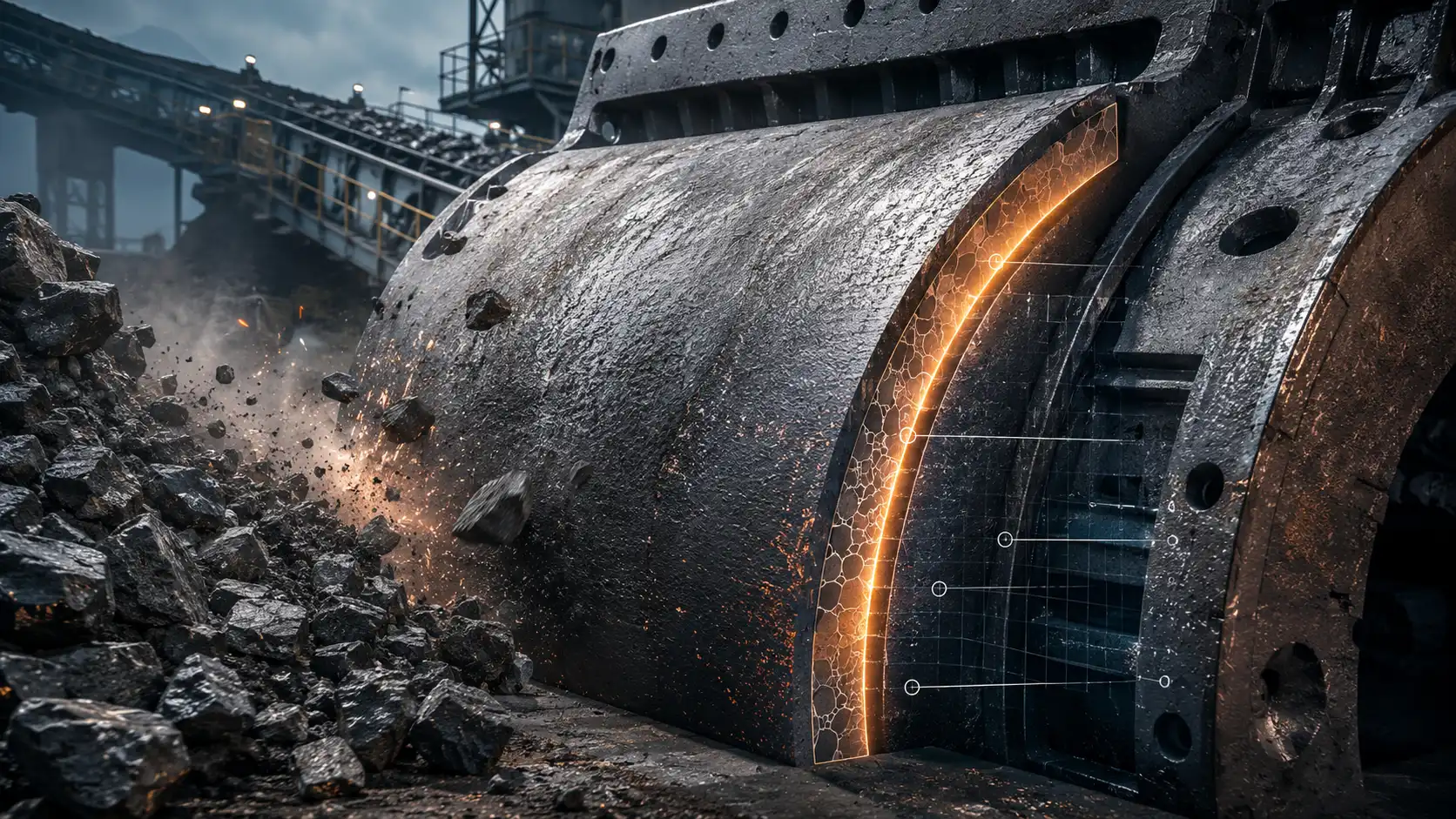
Dans les environnements industriels difficiles tels que l'exploitation minière, le concassage et la métallurgie, la défaillance de l'équipement est rarement une option. Lorsque les composants internes sont confrontés à des chocs incessants et à une abrasion intense, le choix du bon alliage de base est la clé ultime pour minimiser les temps d'arrêt coûteux et prolonger la durée de vie des pièces moulées lourdes. C'est là que la science éprouvée de l'écrouissage offre un avantage qui change la donne pour les fabricants OEM.
Contrairement aux aciers au carbone standard qui s'usent simplement sous l'effet de lourdes charges mécaniques, les alliages d'écrouissage spécialisés se transforment activement en service. Ils développent une surface extérieure ultra-dure et durable tout en conservant un noyau dur et ductile qui empêche les fissures catastrophiques. Dans cet article, nous étudierons le fonctionnement de ce mécanisme unique de résistance à l'usure et les raisons pour lesquelles il est essentiel pour réduire le coût total de possession (TCO) dans les applications lourdes.
SCIENCE ET INGÉNIERIE DES MATÉRIAUX
TIRER PARTI DE LA SCIENCE DES MATÉRIAUX POUR
ABAISSER LE TCO DANS LES CAS GRAVES
APPLICATIONS OEM.
Lire l'article
L'équipe d'ingénierie de Hanhai
13 mai 2026 | 6 MIN LIRE
SOMMAIRE
- 1. Qu'est-ce que l'écrouissage dans la science des métaux ?
- 2. Le rôle essentiel de l'écrouissage dans l'allongement de la durée de vie des pièces moulées lourdes
- 3. Les meilleurs alliages d'écrouissage pour les pièces industrielles OEM
- 4. Applications réelles dans les équipements miniers et métallurgiques
- 5. Partenariat avec Hanhai Casting pour des pièces moulées OEM à haute durabilité
1. Qu'est-ce que l'écrouissage dans la science des métaux ?
Pour comprendre comment les composants à hautes performances survivent aux environnements industriels sévères, nous devons d'abord nous pencher sur la science du comportement des métaux de base sous contrainte mécanique. L'écrouissage, également connu en métallurgie sous le nom d'écrouissage par déformation, est un processus fondamental qui permet d'allonger la durée de vie des pièces moulées lourdes : un métal devient plus résistant et plus dur lorsqu'il est déformé plastiquement.
1.1 Explication du mécanisme d'écrouissage
Au niveau microscopique, les métaux sont constitués d'une structure cristalline régulière. Lorsqu'une pièce moulée OEM est soumise à des impacts mécaniques importants ou à des contraintes élevées, des défauts microscopiques au sein de ce réseau, connus sous le nom de dislocations, commencent à se déplacer.
Lorsqu'une énergie cinétique continue est appliquée, ces dislocations se multiplient et interagissent les unes avec les autres. Elles finissent par s'enchevêtrer et s'empiler aux joints de grains, agissant comme des barrages routiers internes. Cette accumulation dense rend la poursuite de la déformation plastique de plus en plus difficile. Par conséquent, la limite d'élasticité et la dureté superficielle du matériau augmentent considérablement dans les zones exactes où la contrainte mécanique est concentrée.
1.2 L'avantage : La surface ultra-dure rencontre le noyau ductile
Les aciers au carbone traditionnels trempés à cœur sont confrontés à un dilemme technique critique : si le métal est suffisamment dur pour résister à l'usure superficielle, il devient cassant et très susceptible de se fissurer en cas d'impact important.
Les alliages d'écrouissage contournent totalement cette limitation. Avant d'être mises en service, ces pièces moulées possèdent une dureté initiale relativement modérée combinée à une ductilité interne exceptionnelle. Une fois les impacts opérationnels survenus, seule la couche externe se transforme en une armure ultra-dure. Le noyau interne non exposé reste dur et flexible, capable d'absorber des ondes de choc massives sans se briser.
2. Le rôle essentiel de l'écrouissage dans l'allongement de la durée de vie des pièces moulées lourdes
Pour les responsables des achats et les ingénieurs, la sélection des matériaux a un impact direct sur la continuité des opérations. L'utilisation du mécanisme d'écrouissage est l'une des stratégies d'ingénierie les plus fiables pour prolonger la durée de vie des pièces moulées lourdes dans des environnements agressifs.
2.1 Auto-renouvellement continu sous l'effet de fortes contraintes
La véritable beauté d'un moulage par écrouissage réside dans sa capacité dynamique à régénérer son propre bouclier résistant à l'usure. Lorsque des matériaux abrasifs (tels que des minerais bruts ou des déchets métalliques) finissent par gruger la surface extérieure durcie, le métal sous-jacent nouvellement exposé est immédiatement soumis aux mêmes impacts opérationnels.
Cela déclenche une transformation localisée instantanée, provoquant le durcissement immédiat de la couche fraîche. Cela crée un cycle continu et auto-renouvelant de résistance à l'usure qui persiste jusqu'à ce que le composant atteigne son épaisseur de fin de vie absolue, prolongeant avec succès la durée de vie des pièces moulées lourdes bien au-delà des capacités des alliages standard.
2.2 Réduction drastique des temps d'arrêt de la maintenance et du coût total de possession
L'usure des composants n'est pas seulement un problème matériel, c'est aussi une variable financière majeure. Les remplacements fréquents de pièces entraînent des arrêts de maintenance prolongés, une augmentation des coûts de main-d'œuvre et une perte de capacité de production.
En se concentrant sur l'allongement de la durée de vie des pièces moulées lourdes grâce à des matériaux d'écrouissage avancés, les opérations permettent d'obtenir un taux d'usure global nettement inférieur. Les pièces restent en service deux à trois fois plus longtemps que les alternatives standard en acier au carbone, ce qui optimise directement le coût total de possession (TCO) du site.
CONSEIL EN MATIÈRE DE MARCHÉS PUBLICS Pour aller plus loin dans l'optimisation des dépenses liées aux pièces OEM, consultez notre analyse complète du coût total de possession réel en 2026 : Fabrication intégrée vs. multi-sourcing pour les pièces moulées OEM.3. Les meilleurs alliages d'écrouissage pour les pièces industrielles OEM
Tous les métaux ne présentent pas des propriétés d'écrouissage significatives. Pour obtenir des performances optimales sur le terrain, il faut choisir la nuance d'alliage spécifique conçue pour votre charge opérationnelle.
3.1 Acier austénitique au manganèse (Hadfield Steel)
Inventé par Sir Robert Hadfield, l'acier austénitique au manganèse (contenant typiquement 11% à 14% de manganèse et 1,0% à 1,4% de carbone) reste le roi incontesté des alliages d'écrouissage.
- État initial : Livré avec une dureté initiale d'environ 200 HB (Brinell Hardness), ce qui le rend très résistant et absorbe les chocs.
- État opérationnel : Sous l'effet d'une forte pression, la couche superficielle durcit rapidement jusqu'à 500 HB ou plus, offrant une résistance exceptionnelle à l'abrasion par gougeage sous forte contrainte.
3.2 Aciers inoxydables spécialisés et ajouts d'alliages
Pour les environnements qui combinent l'usure mécanique avec une corrosion sévère ou des températures élevées, des aciers inoxydables austénitiques spécifiques sont utilisés. En outre, les fonderies modernes introduisent fréquemment des éléments d'alliage personnalisés tels que le chrome (Cr) ou le molybdène (Mo) dans les matrices de manganèse de base. Ces ajouts permettent d'affiner la limite d'élasticité initiale et d'accélérer le taux d'écrouissage pour répondre aux exigences très spécifiques des équipements OEM.
4. Applications réelles dans les équipements miniers et métallurgiques
Les avantages de l'écrouissage se manifestent le mieux dans les machines soumises à un impact cinétique incessant et à un frottement de compression élevé.
4.1 Chemises, manchons et plaques d'usure de concasseurs
Dans les opérations de traitement des agrégats et d'exploitation minière, les pièces internes des équipements sont soumises à des agressions constantes. Les composants tels que les manchons de concasseurs à cône, les revêtements de cuve et les matrices de concasseurs à mâchoires dépendent fortement de l'écrouissage. L'action d'écrasement des roches contre la surface métallique génère l'énergie d'impact nécessaire pour maintenir la couche d'usure dure, évitant ainsi une dégradation prématurée.
LECTURE CONNEXE Vous êtes curieux de savoir comment les différents matériaux d'usure se comparent ? Lisez notre analyse comparative sur la maximisation de la durée de vie des concasseurs : Comparaison entre l'acier au manganèse et les pièces moulées à haute teneur en chrome.4.2 Manutention de matériaux lourds et pots à scories
Dans les aciéries et les installations métallurgiques, les châssis d'équipements lourds, les carters de broyeurs et les composants manipulant des matériaux abrasifs en vrac sont soumis à des contraintes opérationnelles intenses. Même les grandes pièces moulées sur mesure, telles que les installations de manutention des scories soumises à des chocs physiques et au raclage, bénéficient de sélections d'alliages spécialisés qui résistent à la déformation mécanique et à la fatigue structurelle sur de longs cycles de fonctionnement.
5. Partenariat avec Hanhai Casting pour des pièces moulées OEM à haute durabilité
Maximiser le potentiel d'écrouissage d'un composant industriel exige un contrôle métallurgique précis. Si la composition chimique est légèrement différente ou si le traitement thermique critique de trempe à l'eau est mal exécuté, l'alliage ne parviendra pas à développer sa structure entièrement austénitique, ce qui entraînera une défaillance prématurée sur le terrain.
Chez Hanhai Casting, nous sommes spécialisés dans la conception de pièces moulées en acier lourd de haute intégrité et résistantes à l'usure, adaptées aux spécifications rigoureuses des fabricants d'équipement d'origine. Nos capacités de fonderie intégrées garantissent :
- Vérification stricte de la chimie à l'aide de la spectrométrie d'émission optique avancée.
- Cycles de traitement thermique contrôlés conçu pour maximiser la ductilité de la base et la réactivité de l'écrouissage.
- Usinage CNC de précision pour garantir l'assemblage des équipements industriels à tolérances serrées.
Prêt à améliorer la fiabilité de votre équipement ? Contactez l'équipe d'ingénieurs de Hanhai Casting dès aujourd'hui pour discuter de solutions éprouvées permettant d'allonger la durée de vie des pièces moulées lourdes dans vos applications OEM critiques.

 English
 Русский
 العربية
 Español
 Français
 简体中文
简体中文