


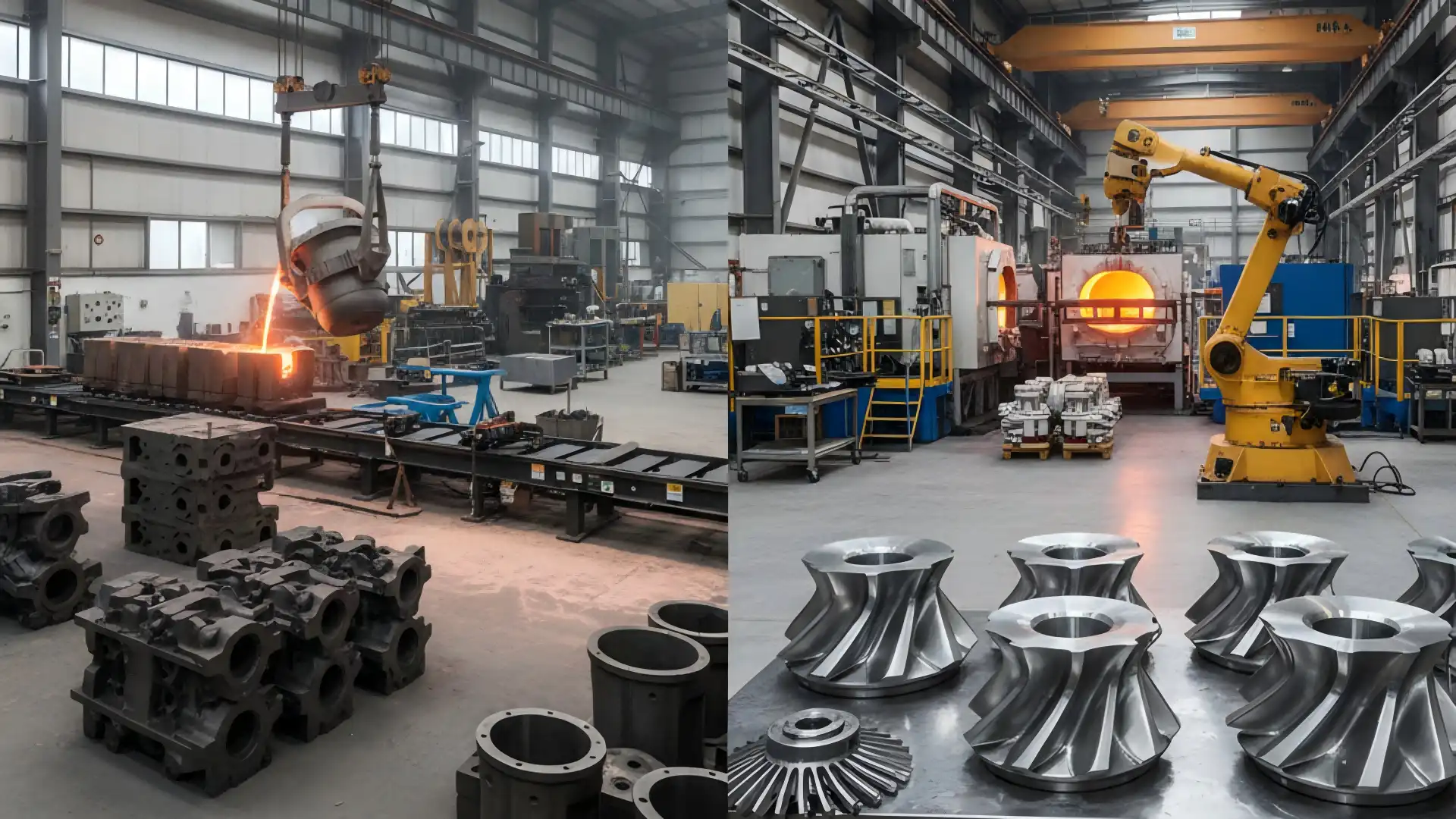
When sourcing parts for mining equipment and heavy machinery, selecting the right casting process is critical to overall performance and cost control. The decision between Sand Casting vs. Investment Casting influences weight capacity, dimensional accuracy, surface finish, and downstream machining requirements. This guide compares both processes from an engineering and procurement perspective, helping buyers understand how to choose the most suitable manufacturing method for heavy industrial parts.
A practical engineering comparison of sand casting and investment casting, helping buyers select the most efficient and reliable process for heavy industrial components.
Balancing structural integrity, production costs, and surface precision for optimal manufacturing results.
Content Overview
1. Sand Casting vs. Investment Casting: Understanding the Core Process Differences
1.1 Manufacturing Method and Typical Industrial Applications
When evaluating Sand Casting vs. Investment Casting, the most important starting point is understanding how each process works and where it performs best in heavy industrial manufacturing. Both methods are widely used in mining, metallurgy, and machinery production, but they serve very different engineering purposes. Sand casting uses compacted sand molds to create large and durable metal parts, while investment casting relies on wax patterns and ceramic shells to achieve higher precision.
1.2 Structural Capability and Design Flexibility
In the comparison of Sand Casting vs. Investment Casting, sand casting allows thicker walls, larger dimensions, and heavier weights, making it suitable for demanding industrial environments such as crushers or slag handling systems. Investment casting focuses more on design complexity and refined geometry, offering smoother surfaces and more detailed structures for industrial components.
2. Advantages and Limitations of Each Casting Process for Heavy Industrial Parts
2.1 Cost, Tooling, and Production Efficiency
Understanding the strengths of Sand Casting vs. Investment Casting helps buyers control project budgets. Sand casting generally requires lower tooling investment and faster setup, which is ideal for large industrial equipment or custom projects. Investment casting involves higher tooling costs but can reduce secondary machining time due to its near-net-shape manufacturing capability.
2.2 Surface Finish, Accuracy, and Machining Needs
Investment casting provides superior surface finish and tighter dimensional tolerances, which is beneficial for precision parts. In contrast, sand casting emphasizes structural strength and scalability. While machining may be required after sand casting, it remains one of the most economical solutions for heavy industrial applications.
3. Key Engineering Factors When Choosing Between Sand Casting and Investment Casting
3.1 Weight Capacity and Part Complexity
When comparing Sand Casting vs. Investment Casting, part weight and structural demands play a major role. Sand casting is typically chosen for large mining machinery components and heavy steel structures, while investment casting suits smaller parts requiring intricate designs and controlled tolerances.
3.2 Material Selection and Performance Requirements
Both processes support various alloy options, but sand casting is often preferred for wear-resistant steels and heavy-duty industrial materials. Investment casting performs best when consistent detail, thin sections, or high surface quality are required to meet engineering specifications.
4. How to Choose the Right Casting Process for Heavy Industrial Projects
In real procurement scenarios, selecting between Sand Casting vs. Investment Casting depends on production goals and application requirements. For large, heavy-duty equipment, sand casting usually delivers better cost efficiency and structural reliability. When precision and reduced machining are critical, investment casting becomes the preferred solution. Evaluating production volume, tolerance expectations, and long-term performance requirements will help buyers choose the most suitable casting process for heavy industrial parts.
Summary
"Choosing between Sand Casting and Investment Casting depends on the 'Scale vs. Precision' tradeoff. Use Sand Casting for large, heavy-duty structural parts, and reserve Investment Casting for smaller, high-precision components requiring minimal machining."