



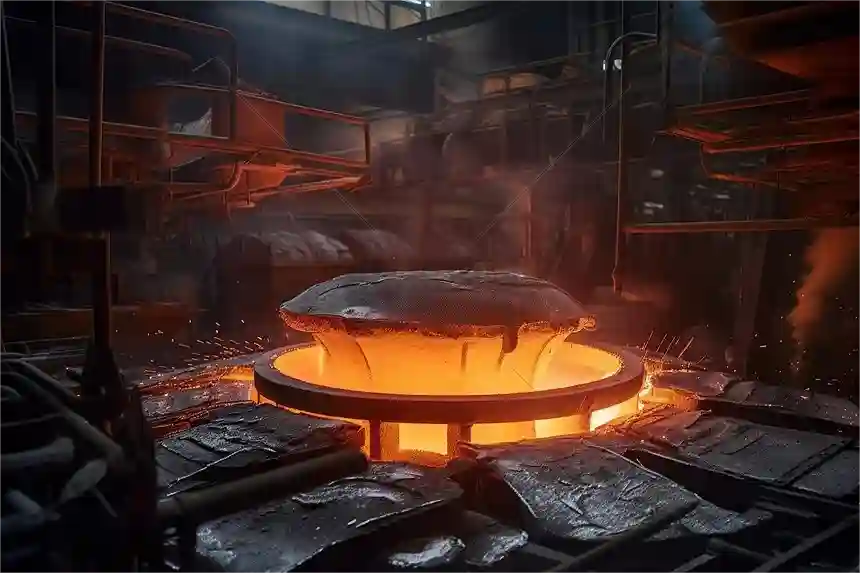
How Heavy Steel Castings Power the Mining and Cement Industry
In the mining and cement sectors, heavy steel castings are the foundation of reliability. From rotary kiln tyres and girth gears to mill housings and crusher bases, every part must withstand extreme loads and temperatures while keeping precise alignment.
Why Heavy Steel Castings Matter
Compared with welded fabrications, integrated heavy steel castings provide uniform mechanical properties, fewer stress concentration points, and greater rigidity. The result is lower vibration, longer service life, and reduced risk of fatigue failure—critical in capital-intensive plants where downtime is costly.
- Uniformity: One-piece structures minimize weld defects and distortion.
- Accuracy: CNC machining maintains precise bore and gear tolerances.
- Strength & fatigue resistance: Heat treatment stabilizes the microstructure for heavy-duty cycles.
- Maintainability: Better alignment and rigidity cut unplanned maintenance and energy loss.
Key Applications of Heavy Steel Castings
- Rotary kiln tyres & girth gears: Support and drive the kiln shell for long-term operation.
- Support & thrust rollers: Maintain accurate alignment and smooth rotation.
- Mill housings & end covers: Ensure grinding stability and reduce vibration.
- Crusher frames & bases: Withstand shock loads and abrasive environments.
Learn more about casting standards at ASTM International. Explore our internal page: Rotary Kiln Components.
Materials, Inspection & Machining
HanHai Casting manufactures large components using high-quality carbon and alloy steels such as ZG230-450 and ZG270-500, known for toughness, wear resistance, and fatigue strength. Each casting follows a controlled process:
- Melting & Metallurgy: Spectro analysis verifies chemistry; refining ensures purity.
- Heat Treatment: Annealing, normalizing, and stress relief to stabilize structure and hardness.
- NDT: UT/MT/RT per EN ISO 17640 / ASTM A609.
- Precision Machining: CNC gantry milling, boring, and finishing for installation-ready accuracy.
Design for Reliability
Our engineers use 3D simulation and metallurgical modeling to optimize flow, feeding, and solidification—reducing internal defects and improving mechanical integrity. CMM inspection reports verify dimensional precision for every shipment.
Logistics & Export Readiness
Because heavy steel castings are massive, HanHai provides export-standard packaging, rust prevention, and ISO documentation to ensure safe global delivery.
Why Choose HanHai Casting
- End-to-end capability: Simulation → casting → heat treatment → machining → inspection → export.
- Certifications: ISO 9001 & ISO 14001 certified, meeting global foundry standards.
- Industry expertise: Rotary kilns, mills, crushers, and structural bases for heavy industry.
- Global trust: Clients across Asia, the Middle East, and Europe rely on our durability and accuracy.
Get a Quote or learn more on our Services page.
FAQ: Heavy Steel Castings for Mining & Cement
Which steel grades are commonly used?
Carbon and alloy steels such as ZG230-450 and ZG270-500 are widely used for heavy steel castings due to their strength and fatigue resistance.
What standards are followed for inspection?
All castings are tested using UT, MT, and RT per ISO and ASTM standards, ensuring structural integrity and dimensional precision.
Do you provide export documentation?
Yes. HanHai Casting supplies packing lists, inspection certificates, and rust-proof packaging to simplify global shipping.
Where can I learn more about foundry processes?
You can follow HanHai Casting on LinkedIn for updates on heavy casting technology and project showcases.
Conclusion: Heavy steel castings are the backbone of heavy industry—delivering the strength, accuracy, and reliability that welded structures cannot match. Contact HanHai Casting today for your next mining or cement project.